What is Java Full Stack Development?
Java Full Stack Development involves the integration of both front-end and back-end technologies to build complete web applications. As part of this process, Spring Boot with ReactJS allows developers to create dynamic and interactive user interfaces on the front end, while ensuring robust server-side functionalities using Spring Boot.
Technologies Used in Java Full Stack Development
Java Full Stack developers usually use a Java Full Stack Development method, where they combine Spring Boot and ReactJS. With ReactJS being the front-end framework, the back-end framework used is Spring Boot, which is efficient for developing applications that are both horizontally scalable and production-ready.
Front-end
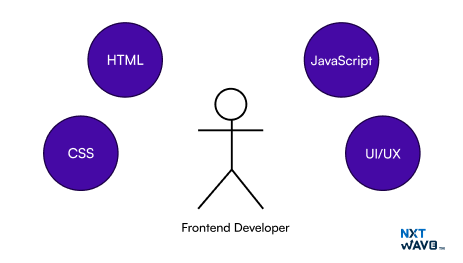
The front end of a web application is the part that the user can see or use. In Java Full Stack Development, the main tools for the user interfaces are ReactJS, Angular, HTML, CSS, and JavaScript. These are the tools which make the web pages interactive, responsive, and user-friendly. The description of the use of each technology is given below:
- ReactJS: A JavaScript library for building user interfaces, particularly single-page applications.
- Angular: It is a TypeScript-based open-source framework used for developing advanced web applications.
- HTML: Generally used for developing web pages and web applications.
- CSS: The language used to describe a document's presentation in HTML.
- JavaScript: A high-level programming language used for creating interactive and dynamic web content.
Back-end
Application's back end is the part that deals with the data, logic, and server-side operations. In the Java Full Stack ecosystem, the trio of Spring Boot, Hibernate, and Java EE has become the go-to choice for the development of server-side applications that are both effective and scalable. While Spring Boot makes the backend process easier, Hibernate offers an ORM solution that eases the database communication. Let’s look at each of the technologies:
- Spring Boot: A Java framework that helps you to create simple, ready-to-use, production-level applications, that require very little configuration.
- Hibernate: An ORM (object-relational mapping) toolkit that is designed to make database operations easier by representing Java objects as database tables.
- Java EE: The group of specifications which defines the characteristics of an enterprise-level Java application, including features such as distributed computing and web services.
Database
Databases are crucial for storing and retrieving data in a web application. In Full Stack Java Development, MySQL (a relational database) and MongoDB (a NoSQL database) are commonly used to manage data. These databases provide a robust storage solution for dynamic web applications. The technologies can defined as:
- MySQL: An open-source relational database management system (RDBMS) based on SQL.
- MongoDB: An open-source database that stores data in JSON-format documents.
Other Tools
- Docker allows developers to create, deploy, and run applications in containers, making it easier to manage dependencies and ensure consistency across different environments.
- Jenkins is a popular automation server that helps in continuous integration and delivery (CI/CD), enabling automated testing and deployment.
- Git is a version control system used for managing source code changes and collaborating with team members.
Quick Note: The modern Java Full Stack developer must be proficient in one front-end framework (React is currently dominant) but must be an expert in Spring Boot and its ecosystem (Security, Data JPA).
Java Full Stack Project Ideas for 2025
Here are Java Full Stack Projects with Source Code for 2025 that can enhance your skills and showcase your abilities in real-world applications such as:
1. Job and Portfolio Websites
Job and Portfolio Websites are platforms designed for showcasing personal achievements, managing resumes, and applying for jobs. Using Java full stack development, these applications offer features like project showcases, resume uploads, job listings, and application tracking. They may also include integrations with professional networks, advanced search, and location-based job displays for a comprehensive user experience.
Front-end Technologies
- React: Creates interactive interfaces that allow users to log jobs, watch portfolios, or store applications.
- HTML: Summarizes the content related to resumes, projects, job offers, and professional profiles.
- CSS: Gives a profile page, job cards, or an image gallery the latest design and adapts it to various screen sizes.
- JavaScript: Serves the application with newly added data, a full-text search feature, and interactivity through editing/posting.
Back-end Technologies
- Spring Boot / Node.js: Manages all the processes involved in user authentication, application tracking, and integration with external APIs.
- Express: Simplifies the development of RESTful APIs that deal with job posts, user data, and portfolio content.
- MySQL / MongoDB: Keeps user information, resumes, jobs, and application data confidential and available anytime anywhere.
- Elasticsearch: Supports highly efficient job seekers with advanced filtering and discovering skills attracted by the source.
Source Code: https://github.com/topics/personal-portfolio-website
2. To-Do List App
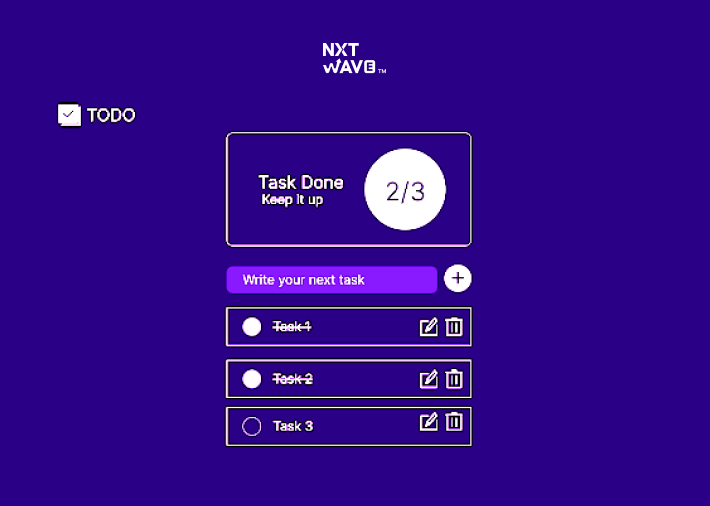
A simple productivity tool which enables users to manage their daily tasks is an app allowing users to add, remove, and prioritize tasks, hence, keeping them organized. By integrating due dates, task categories, and notifications, user experience may also be improved. This app can be synced across devices to allow smooth flow of task management.
Front-end Technologies
- React: A JavaScript library for building user interfaces, allowing efficient and dynamic rendering of task lists.
- HTML: Provides the basic structure for the app's layout and content.
- CSS: Styles the app's layout, colors, fonts, and responsiveness for different devices.
Back-end Technologies
- Node.js: A JavaScript runtime for building server-side applications, enabling back-end functionality and task management.
- Express: A minimal web framework for Node.js, used to build the API and handle requests like adding, removing, or updating tasks.
- MongoDB: A NoSQL database used to store and manage task data, supporting dynamic and flexible document structures for tasks.
Source Code:https://github.com/5codeman/TO-DO-LIST
3. Weather Application
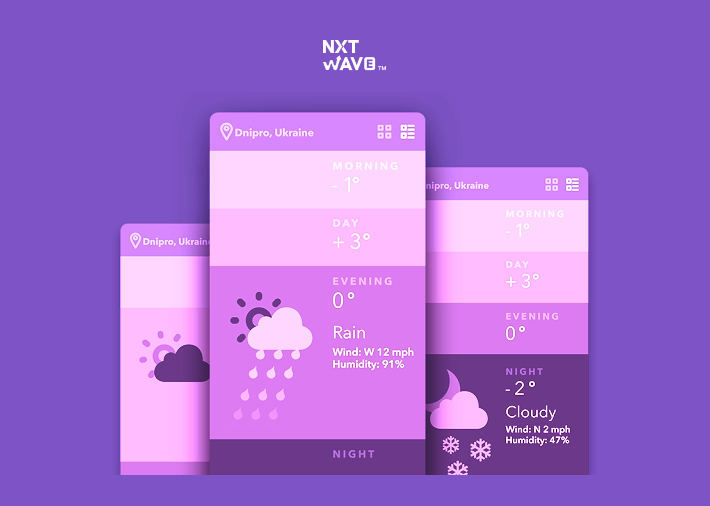
An application that allows users to view real-time weather forecasts based on location or city name. The app pulls weather data from third-party APIs like OpenWeatherMap, displaying details such as temperature, humidity, wind speed, and weather conditions. It can also offer additional features such as weather alerts, radar maps, and historical data.
Front-end Technologies
- React: A JavaScript library for building interactive and dynamic user interfaces, used for displaying weather data and updates in real time.
- HTML: Provides the basic structure for the app’s layout, such as sections for temperature, wind speed, and other weather details.
- CSS: Styles the app, ensuring a visually appealing design with responsiveness for various devices.
Back-end Technologies
- Node.js: A JavaScript runtime for building server-side functionality, fetching weather data from APIs, and handling user requests.
- Express: A web framework for Node.js used to create RESTful APIs for interacting with third-party weather APIs and processing requests.
- NoSQL: A flexible database used to store user preferences, such as favorite cities or preferred temperature units (Celsius/Fahrenheit).
Source Code: https://github.com/kaushalsahu07/weather
4. E-Commerce Platform
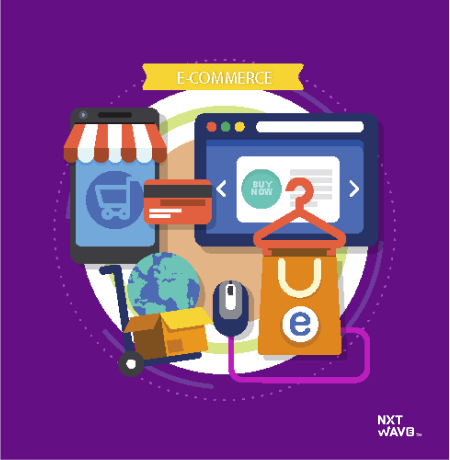
An E-Commerce Platform is a digital platform that allows consumers to purchase products and individuals to sell items over the internet in an easy and efficient way. To name only a few of its characteristics such as product catalogs, secure authentication, shopping carts, and integrated payment gateways, these platforms built with Java full stack technologies manage everything from user profiles and order tracking to inventory and transactions, thereby, guaranteeing a sound and scalable online shopping system.
Front-end Technologies
- React: It is responsible for the creation of product browsing, cart management, and checkout flows.
- HTML: It provides the basic layout of product pages, shopping carts, user profiles, and order history sections.
- CSS: It is mainly used to the style of product listings, navigation menus, and user dashboards with a modern and responsive appearance.
- JavaScript: It is responsible for making dynamic content updates, implementing the search functionality, and creating interactive shopping experiences.
Back-end Technologies
- Spring Boot / Node.js: It is responsible for dealing with business logic, authentication, order processing and also integration with payment gateways.
- Express: It makes the development of RESTful APIs for managing products, carts, orders, and user sessions easier.
- MySQL / MongoDB: It is a database management system that is secure and scalable, meant for storing user data, product catalogs, order history, and transactions.
Source Code: https://github.com/topics/e-commerce
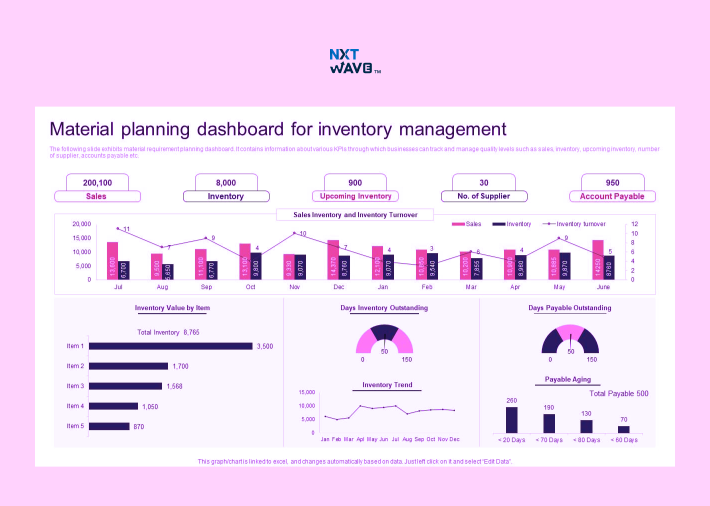
5. Inventory Management System
Applications called Inventory and Directory Management Systems provide a method for organizing and managing inventories, contacts, or a directory of an organization. Using a Java full stack framework, these systems offer powerful CRUD capabilities, advanced search features, and full service administration. They are useful for any business or organization that needs to track products, manage contacts, or manage resources across a variety of places.
Front-end Technologies
- React Native: Builds responsive interfaces for inventory tracking and directory management on web and mobile devices.
- HTML: Structures product lists, contact directories, and administrative panels.
- CSS: Styles inventory dashboards, forms, and search interfaces for usability and clarity.
- JavaScript: Powers interactive features like dynamic searches, filtering, and real-time updates.
Back-end Technologies
- Node.js with Express / Django: These technologies manage CRUD operations, business logic as well as API endpoints that allow inventories and directories to be managed.
- MySQL / MongoDB / Firebase: These platforms offer reliable storage for data related to inventories, contacts, and directories that can scale up as needed.
- JDBC API / Swing: They provide the easy open standard for connecting Java-based desktop clients to the database.
- Stripe: Allows the integration of payment processing functionalities for inventory systems that need to facilitate transactions.
- Google Maps API: Enables location visualization for inventories and contact directories.
Source Code: https://github.com/AsjadIqbal/InventoryManagementSystem
6. Fitness and Workout Tracker
The fitness and workout tracker app allows users to keep a record of their physical activities, see how far they have come with their fitness goals, and track their health data in a clear and concise manner. Usually, such a platform comes with features like a dashboard where users can get real-time feedback, an exercise library, fitness plans that can be customized, and handy gadgets for health can be integrated. Users can track data such as walking distance and heart rate, get alerts, set a workout time, and participate in the social features of the app by, for example, sharing their progress and joining in on competitions with other users.
Front-end Technologies
- HTML: Defines the user interface elements, for example, dashboards, workout logs, and progress charts.
- CSS: Gives the application a beautiful and responsive interface which is user-friendly.
- JavaScript: Offers the user the possibility to interact with various features by, e.g., real-time updates, reminders, and scheduling of tasks.
- React: Facilitates the creation of dynamic and updated components for dashboards, exercise libraries, and workout plan management.
- Chart.js: Makes charts and graphs interactive so visually appreciable user progress, heart rate, and activity trends over time.
Back-end Technologies
- Spring Boot: Handles the logic of the business side, user data, workout sessions, and API that are secure.
- MySQL / MongoDB: Keeps user profiles, workout logs, progress data, and scheduling information.
- Fitbit API / HealthKit: Connects to the wearables so health metrics like heart rate and steps can be tracked and recorded.
Source Code: https://github.com/kunaal438/blogging-site
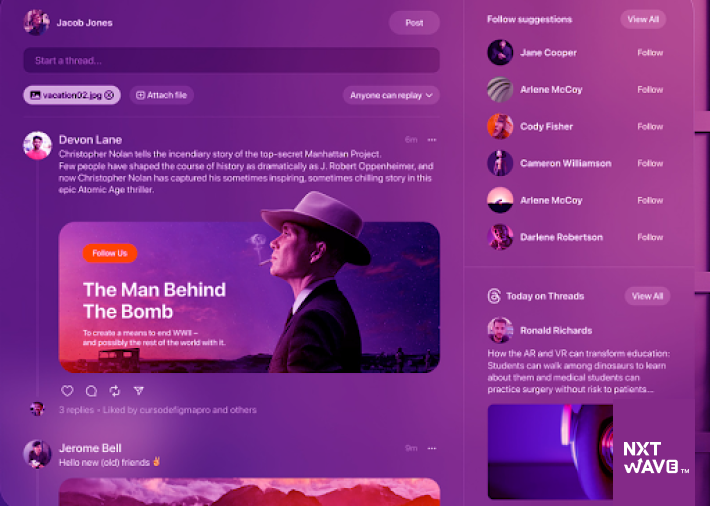
7. Social Media Platform
Social Media Applications are platforms designed for rich user interaction, enabling functionalities like user profiles, posts, messaging, and real-time updates. Built with Java full stack frameworks, these systems support scalable data management, real-time communication, and seamless media sharing, making them ideal for modern social networking experiences.
Front-end Technologies
- React Native: Works to create mobile-friendly, interactive interfaces for user feeds, profiles, and messaging.
- HTML: Defines the structure of user profiles, post layouts, and chat interfaces.
- CSS: Gives the visual format of timelines, notification panels, and media galleries to make them visually appealing.
- JavaScript: Enables dynamic updates, real-time notifications, and interactive features to be carried out.
Back-end Technologies
- Node.js with Express: Manages RESTful APIs for posts, messaging, user management, and notifications.
- MongoDB: Keeps user profiles, posts, messages, and media uploads for flexible, and scalable data management.
- Redis: Provides support for caching, thereby enabling fast data retrieval and improved application performance.
- Socket.io: Allows the occurrence of real-time messaging and live updates across the platform.
- AWS for Media Storage: Delivers storage that is not only reliable and scalable but is also for user-uploaded images, videos, or any other media.
- OAuth: Offers user authentication and makes available the social login options.
Source Code: https://github.com/topics/social-media-app?o=desc&s=
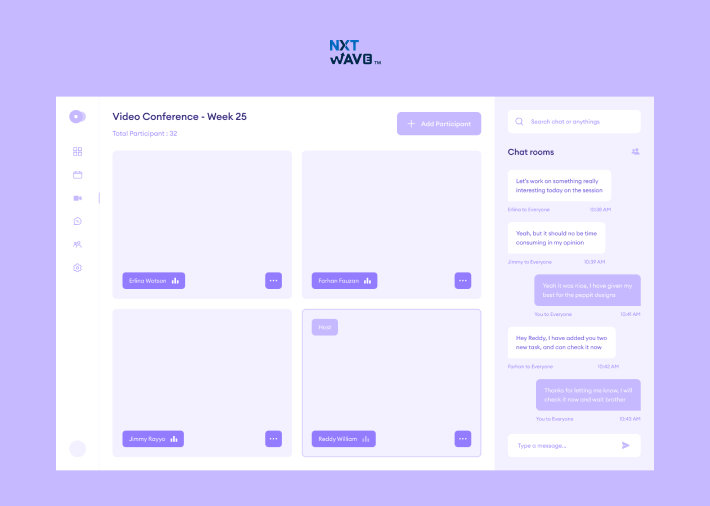
8. Video Conferencing App
It is a platform on the web that allows users to connect through video meetings, conduct webinars, or hold virtual classes. The application also facilitates communication via video and audio, sharing of the computer’s screen, and chat. More features may also be present such as the ability to plan a meeting, record, and interact with other software like calendars and email services. Safe communication is very important.
Front-end Technologies
- HTML: Creates the basic structure for video call interfaces, chat windows, and scheduling options.
- CSS: Gives the app the look and feel that users can easily navigate, with call controls and participant views that are visible.
- JavaScript: Controls the user interactions like click on the link to join the call, turn off your microphone and write a message.
- React: Allows to rapidly create real-time interfaces, showing all the active participants along with shared content.
Back-end Technologies
- Node.js: It is the backend that manages the real-time communication protocols and server-side logic for video conferencing.
- Express: Creates APIs for user management, meeting scheduling, and call data handling.
- Spring Boot: Handles user login, scheduling algorithm, and external tool integration.
- MySQL: Data about users, meeting logs, and schedules are kept in a relational format.
- MongoDB: It is the used for storing the unstructured data like meeting recordings or user preferences.
Source Code: https://github.com/jitsi/jitsi-meet
9. Communication and Messaging Apps
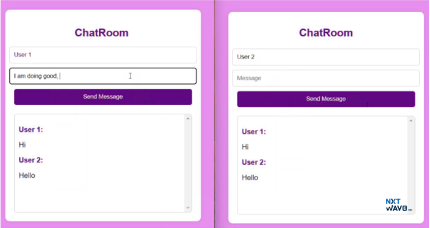
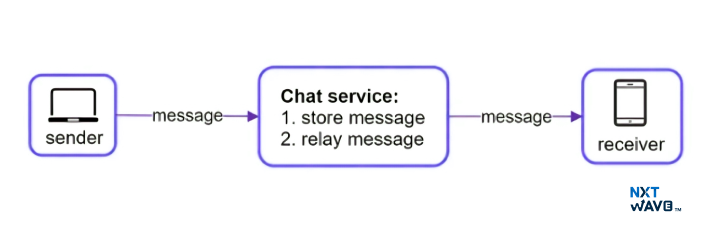
Communication and Messaging Apps enable real-time chat and video conferencing, supporting seamless user communication, notifications, and media sharing. Built with Java full stack technologies, these applications typically feature secure user authentication, data encryption, group messaging, and advanced media management. Additional functionalities may include file sharing, profile viewing, screen sharing, and recording/playback of video sessions.
Front-end Technologies
- React: Creates user interfaces that are interactive for chat windows, video calls, and notifications.
- HTML: Defines the structure of chat interfaces, video conferencing layouts, and user profile pages.
- CSS: Designs chat bubbles, participant lists, and video call screens to be modern and responsive.
- JavaScript: Enables all changes that occur to be seen instantly, allows the sharing of different types of media, informs users of activities happening, and provides interactive features.
Back-end Technologies
- Spring Boot: Oversees user validation, message routing, media control, and video session management.
- Node.js: Enables real-time communication protocols, and server-side logic for chat and video features.
- Express: Facilitates the building of RESTful APIs for user management, group messaging, and media sharing.
- MySQL / MongoDB: Persist user profiles, chat logs, media files, and video session data.
Source Code: https://github.com/chaudhary19/Realtime-Chat-App
10. Online Crowdfunding Platform
Users can set up and back fundraising projects via an Online Crowdfunding Platform that gives them easy-to-use campaign administration, safe money handling, and active user interaction. Generally, the platform allows a contributor to benefit from a reward-based campaign where they receive an incentive in return for their financial support. Powered by Java full stack technologies, such systems ensure a smooth journey for both the originators and the supporters of the fund.
Front-end Technologies
- React.js / Angular: Creates dynamic, responsive interfaces for campaign creation, dashboards, and user engagement.
- HTML: Defines the layout of campaign pages, dashboards, and user profiles.
- CSS: The platform is visually designed by CSS for an attractive and user-friendly experience.
- JavaScript: User interactivity is JavaScript provided for real-time campaign updates, payment flows, and notifications.
Back-end Technologies
- Spring Boot / Node.js: Manages the business logic, campaign administration, and the services integration with the payment system.
- Express: Makes it easy to build RESTful APIs for campaign data, user actions, and payment processes.
- MongoDB: With a storage solution for campaign details, user data, pledges, and transaction histories, it allows data management to be both scalable and flexible.
- JWT: Keeps the security of user authentication and authorization at every point of the platform.
Source Code: https://github.com/topics/crowdfunding-platform
11. Content Management System (CMS)
The Java full stack solution can make a CMS (content management system) more powerful, offering services such as secured database management, role-based access control, and administrative interfaces, which can be customized according to the user. A CMS is a user-friendly software package that allows the user to add, edit, and manage content in a quick and convenient way. Some of the essential features of the system are drag-and-drop interfaces, responsive dashboards, and adaptable publishing tools, which facilitate the use of CMS in websites, blogs, and enterprise content platforms.
Front-end Technologies
- React: Builds a responsive dashboard interface for content creation, editing, and management.
- HTML: Structures content pages, forms, and administrative panels.
- CSS: Styles the CMS for a user-friendly and visually appealing experience.
- JavaScript: Adds interactivity, such as drag-and-drop content blocks and live editing.
- CKEditor / TinyMCE: Integrates rich text editing capabilities for advanced content formatting.
Back-end Technologies
- Node.js with Express / Django: Basically, these are the tools required to implement the server-side logic, perform content operations, and open API endpoints for user, roles, and content administration.
- MySQL / PostgreSQL: Serves as a secure, orderly database management system for content storage, user data storage, and publishing history.
- Redis: Caching is made possible by Redis with the goal of increasing performance and scalability.
- AWS S3: Supports media storage that is dependable for images, videos, and other digital assets.
Source Code: https://github.com/topics/content-management-system
12. Data Analytics Applications
Data Analytics Applications are designed to collect, process, and visualize large volumes of data, enabling users to gain actionable insights through interactive dashboards and reporting tools. Built with Java full stack technologies, these platforms often integrate advanced analytics, real-time data processing, and powerful visualization features to support data-driven decision-making.
Front-end Technologies
- React: Builds dynamic dashboards and interactive analytics interfaces.
- HTML: Structures data tables, charts, and reporting components.
- CSS: Styles dashboards and visualizations for clarity and responsiveness.
- JavaScript / D3.js: Powers interactive data visualization, custom charts, and dynamic updates.
Back-end Technologies
- Spring Boot / Node.js: Manages data processing, API endpoints, and business logic.
- Python with Flask / Django: Handles advanced analytics, data transformation, and integration with scientific libraries like Pandas and Matplotlib.
- MongoDB / PostgreSQL / BigQuery: Stores structured and unstructured data, supporting scalable analytics and efficient querying.
- Apache Spark: Processes and analyzes large datasets in real time or batch mode for high-performance analytics.
Source Code: https://github.com/topics/data-analytics
Bottom Line: Select a project that challenges you to implement a Spring Security layer and use Docker for deployment—these are non-negotiable for a modern Java Full Stack role.
Key Features to Include in Your Projects
When developing a project, whether a website, mobile app, or software application it is important to integrate key features that enhance both functionality and user experience. These features also help ensure the application performs well under different conditions, scales properly, and delivers meaningful experiences to its users. Below is a detailed breakdown of these features:
- Database Management: Full stack Java developers should be able to efficiently manage databases. To do so, they must have knowledge about storing, retrieving, and updating data with the help of SQL and database management systems (DBMS), for instance.
- Web Architecture: It is essential to have the knowledge of web architecture which includes the understanding of how java server pages(JSP), servlets, and APIs are used to build web applications.
- Frontend Development: Some related technologies in the front end, the likes of HTML, CSS, and JavaScript, require your skill. The use of frameworks such as React, Angular, or Vue.js is also possible for the further development of the user interface.
- Backend Development: Backend development just refers to a situation where the server-side logic and data storage are taken care. The use of Node.js, Express, or Django technologies makes this work possible.
- Microservices: It is the knowledge of microservices and the implementation of its architecture that makes one able to segregate an overlarge application into smaller, lighter, and independent service modules. The beneficial aspects of this are scalability and maintainability.
- Testing: Among the priorities of programming is the creation of robust unit and integration tests. One can use various testing frameworks like Junit or Mockito to make the application meet the standard of quality.
- Project Management: The functions of task scheduling, progress tracking, and resource management, among others, are indispensable to the proper running of projects. The use of Gantt charts and budgeting features can be a way to simplify project management.
- Security: The incorporation of encrypted payment methods and the guarantee of data security constitute the core of the application that deals with sensitive information.
- Integration with APIs: Some of the external API such as Google Maps for delivery tracking, Stripe for payment processing, and Twilio for short messages notifications can be used for easy, quick completions of tasks within the app. As a result, it is the app that becomes more functional.
What Makes a Good Project?
A good project not only addresses real-world issues but also reflects your strong command of essential technologies. Such a project can only be your complete application development through the use of the front-end and back-end. The project will be your for expansion and also your for the proper arrangement of the code.
Moreover, it could also be the case that the project was designed to be user-centric, thus, providing a complete, and even, intuitive experience for the user. The good project identifies a market demand, leverages robust tech, and combines features with good design.
Step-by-Step Approach
A step-by-step approach to building a full-stack project includes:
- Planning: Define the requirements, features, and architecture.
- Design: Create wireframes, UI/UX designs, and database schemas.
- Development: Implement the front-end, back-end, and database.
- Testing: Test the functionality of all parts of the application.
- Deployment: Deploy the application using platforms like Heroku, AWS, or Docker.
GitHub and Open-Source Repositories
Uploading your projects to GitHub makes them accessible to potential employers or collaborators. Open-source contributions show that you're engaged with the developer community and help you build a reputation.
Best Practices
- Write clean, maintainable code.
- Use version control to track changes.
- Implement unit testing and integration testing.
- Adhere to secure coding practices.
Benefits of Working on Java Full Stack Projects
Here are the benefits of working on Java full stack projects:
- Full-stack projects allow you to work on both front-end and back-end, preparing you for real-world job scenarios.
- Completed full-stack projects show potential employers your ability to work on both client-side and server-side code, making you a valuable asset.
- Working on full-stack projects provides experience in all stages of application development, from front-end design to back-end server management and deployment.
Conclusion and Next Steps
Building a portfolio of Java Full Stack projects isn't just about writing code; it's about proving you can be trusted to build and ship an entire application. By focusing on projects powered by Spring Boot and a modern frontend like React, you move beyond specialized coding and demonstrate true engineering maturity.
Why It Matters – Relevance & Implications
Developers who are just knowledgeable in Java and React separately are not as in demand as before in the market. The employers are looking for engineers that have the capability to handle the complete application lifecycle including data modeling in MySQL and containerizing the final deployment on AWS. Such projects propel you to face the actual integration challenges of the industry, thereby making your portfolio the first matching with the enterprise job descriptions.
Practical Advice for Learners – Actionable Next Steps
- Start with CRUD: Build the To-Do List App first to master Spring Boot's data layer and basic REST API creation.
- Add Security: Implement Spring Security into the To-Do List App before moving to a larger project.
- Containerize Everything: Get comfortable with Docker by creating a single Dockerfile for your Spring Boot backend and another for your React frontend, orchestrated via docker-compose.
- Version Control: Commit frequently with meaningful messages, demonstrating a clear Git workflow (branching, merging).
Build the Future You Want With Intensive 3.0 and Real-World Learning!
Explore ProgramFrequently Asked Questions
1. What are the key technologies used in Java full stack development?
Java full stack developers use Java (Spring Boot, Hibernate), front-end technologies (HTML, CSS, JavaScript, React/Angular), databases (MySQL, MongoDB), and tools like Git, Docker, and Maven for development, testing, and deployment.
2. Which types of projects are ideal for full stack developers?
A web-based project like an e-commerce application or a social media platform is ideal. It involves both front-end and back-end development, database integration, and deployment, offering a comprehensive learning experience.
3. What is the step-by-step roadmap for becoming a Java full stack developer?
The roadmap includes learning Java fundamentals, mastering Spring Boot, front-end technologies (HTML, CSS, JavaScript), frameworks (React/Angular), databases (SQL/NoSQL), and version control tools (Git), followed by deploying and maintaining web apps.
4. What is the most effective way to learn Java full stack development?
Start by mastering Java, then move on to Spring Boot for back-end development. Learn front-end technologies (HTML, CSS, JavaScript, React/Angular) and databases. Build projects, contribute to open-source, and practice regularly.





.avif)