What Full Stack Developers Actually Do?
Full stack developers bridge the gap between what users see and the systems that power applications behind the scenes. Their role encompasses the complete technology stack from databases to user interfaces.
Daily Responsibilities
- Front-End Development: The developer builds user interfaces that are adaptable to various devices using HTML, CSS, JavaScript, and the current libraries such as React, Angular, or Vue.js. Besides making applications function smoothly on different devices and browsers, the developer also ensures the applications are visually attractive and easy to use.
- Back-End Development: The developer is responsible for creating the logic for the server side, RESTful APIs, and database activities by using technologies like Node.js, Python (Django/Flask), Java (Spring Boot), or the like. In short, the back end is what gives the power to the things that the user sees and does on the front end.
- Database Management: The developer is in charge of the design and upkeep of the databases. The developer uses SQL-based systems like MySQL or PostgreSQL and also NoSQL products like MongoDB. Writing productive queries and the like fall within data management activities.
- DevOps and Deployment: The team is responsible for handling the deployment of the application, setting up servers, installing CI/CD pipelines, as well as the whole event of production monitoring in order to keep the system reliable.
- Collaboration: Working with product managers, designers, and other developers to identify problems, fix bugs, implement features, and maintain clear communication about technical decisions and project progress.
Quick Note: Cloud computing expertise (AWS, Azure, Google Cloud) has become increasingly valuable in 2025 as companies accelerate cloud migration. Developers with cloud certifications often command 15-20% higher salaries than those without.
Career Outlook for Full Stack Developers
India is evidently leading the world of startups, comprising a whopping 92,683 registered startups in the nation, among which tech startups constitute nearly 27,000. As the number of tech startups continues to grow, organisations are looking for skilled professionals, hoping to leverage their expertise to further expand the growing tech sector.
The versatility of managing both front and back-end technologies is specifically sought after to conserve resources, and as a result, full stack developers are in high demand. Increasing acceptance of remote work is another factor drastically fueling this demand, enabling competent developers to connect with international clients and work on heavily lucrative projects.
According to the US Bureau of Labor Statistics, full stack developer jobs are set to experience a 30% growth in the number of job opportunities, while India’s leading job-finding website Naukri.com extends nearly 41,000 active job opportunities for full stack developers.
The given stats imply a concrete future for full stack aspirants while oncoming technologies such as augmented reality, IoT, mixed web applications, virtual reality and more point towards optimistic growth across diverse realms, making full stack a dynamic and lucrative career to opt for!
Factors Affecting a Full Stack Developer’s Salary in India
Just like global full stack development professionals, the Indian developer community enjoys a successful and profitable career as a full stack developer. According to Payscale, the starting salary for a full stack developer in India ranges from INR 7 LPA to 16 LPA. On the other hand, post building a significant experience and expertise in the domain, the salary for senior full stack developer roles often ranges from INR 9 LPA to 30 LPA, with INR 18.8 LPA as average annual salary.
These figures notably vary based on an array of factors, which may include location, role, employer, skills and more. The best way to land yourself a lucrative opportunity is by comprehending what these factors are and how they impact the amount a company offers you as remuneration.
Let us take a look at a full stack developer's salary based on diverse factors!
Full Stack Developer’s Salary Based on the Location
Work location is a major influencing factor with regard to the salary offered to a full stack developer. More than often, salaries depend on the cost of living, local economic conditions of the region, as well as the country where the employee is based. For instance, the average salary for a full stack developer in the USA and India varies distinctly. However, salaries received in India, in two different cities, such as Pune and Bangalore, also vary based on these factors.
Salaries in metropolitan cities tend to be on the higher side compared to the ones still developing their tech sector. Bangalore being known as the Silicon Valley of India offers a highly competitive salary. Given below is a detailed comparison of salary figures offered across different cities in India.
Quick Note: Remote work has reduced location-based salary gaps significantly. Many companies now offer location-agnostic compensation, allowing developers in smaller cities to earn metro-level salaries while enjoying substantially lower living costs.
| Location |
Average Annual Salary (INR) |
| Bangalore |
806,944 |
| Mumbai |
617,498 |
| Ahmedabad |
481,536 |
| Hyderabad |
792,138 |
| Chennai |
705,366 |
| Pune |
751,465 |
| New Delhi |
591,795 |
Become a sought-after Full Stack Developer with real-world project experience
Explore ProgramFull Stack Developer’s Salary Based on the Employer
Just like the quality of education varies based on the college you enrol in, full stack, or salary for any other role varies based on the type of employer you work under. Salaries vary company-wide, as well as based on the type of industry the company belongs to, which may include finance, entertainment, technology, healthcare and more.
The competitive nature of the industry, along with the company's current market reputation, greatly impacts how well its employees are being paid. Larger companies with significant revenue tend to offer more lucrative opportunities to their employees, compared to startups, just initiating their journey to growth.
Work opportunities under global tech giants like Google are a dream for many aspiring full stack developers. Compared to other companies, Google employees are some of the most well-paid, all thanks to its market reputation, extensive revenue stream and the lucrative job roles they offer, along with a bunch of additional perks.
Let's explore how other prominently known companies are paying their full stack developers on average in India.
| Employer |
Average Annual Salary (INR) |
| Tata Consultancy |
482,800 |
| Infosys |
454,540 |
| Capgemini |
575,000 |
| Cognizant |
600,000 |
| Amazon |
800,000 |
| Google |
888,514 |
| IBM |
880,806 |
Full Stack Developer’s Salary Based on Skills
Full stack developers are required to have a combination of technical and soft skills that are in high demand and will make them acquire higher pay in the ever-changing tech market in India. Employers look for candidates who have both the depth and versatility of the development lifecycle.
Technical Skills
Technical expertise is the foundation of a full stack developer’s earning potential. Proficiency in fundamental programming languages—such as JavaScript, Python, and Java—is essential. Developers should also be comfortable with both browser programming (front-end) and server programming (back-end), using technologies like React, Angular, Node.js, Django, and Spring Boot.
Database programming skills are highly valued, with experience in both SQL (e.g., MySQL, PostgreSQL) and NoSQL (e.g., MongoDB) databases being particularly sought after. Familiarity with version control systems, such as Git, and working knowledge of popular stacks (like LAMP, MEAN, or MERN) further increase a candidate’s marketability.
Employers often look for developers who can leverage web development programs and frameworks to streamline application development, deployment, and maintenance.
Soft Skills
Soft skills, as well, play an important role in salary increment. Good communication and collaboration skills are of utmost importance to achieving stillness among the stakeholders and project delivery. Logical thinking and imagination make developers resolve hard issues and design a user interface that draws attention.
If someone is skilled in negotiation they will get a good initial offer and salary increases in the future while the use of time management and team work will always end in good performance ratings and promotion.
Skill Impact on Salary Prospects
Acquiring and continually updating these in-demand skills can significantly boost a full stack developer’s salary prospects. Developers who combine technical excellence with strong interpersonal abilities are more likely to be considered for senior roles, leadership positions, and high-paying projects. Employers reward those who demonstrate adaptability, initiative, and the capacity to contribute at every stage of the development process.
Here are a few skills and the related salary figures offered to Indian full stack developers on average.
| Employer |
Average Annual Salary (INR) |
| Python |
633,076 |
| SQL |
699,344 |
| Java |
813,280 |
| Node.js |
662,464 |
| Javascript |
649,331 |
| React.js |
680,209 |
| Angular.js |
608,778 |
| Angular |
803,762 |
| .NET |
902,306 |
| Spring |
804,060 |
Key Takeaways: Developers proficient in multiple high-demand technologies can negotiate 25-40% higher salaries. Combining cloud expertise with strong full stack fundamentals provides the best return on learning investment.
Full Stack Developer's Salary Based on Experience
Employees at the senior level receive a high compensation compared to their subordinates at the early or mid-stage of their career. Wondering why? It all comes down to the amount of experience an employee has to manage workload, make decisions, and implement the right skills at the right time. Entry-level or early-career employees hold limited to no professional experience, which makes them prone to commit mistakes.
On the other hand, with years of experience under their belt, employees require little to no help with their work while exhibiting exceptional performance for tasks. Lack of experience hinders performance, timelines as well as revenue that the company aims to generate. With experienced professionals as a part of your team, the chances of delivering better services to their clients are much higher.
Experienced employees are invaluable assets of a company; therefore, the level of experience is an important factor for full stack developers to estimate their salaries. The table below showcases stark differences between the salary figures offered to employees with varying levels of experience. Let's have a look!
| Employer |
Average Annual Salary (INR) |
| Entry Level (0-1 years) |
391,670 |
| Early Level (1- 4 years) |
592,016 |
| Mid Level (5-9 years) |
11,60,428 |
| Experienced (10-19 years) |
18,86,618 |
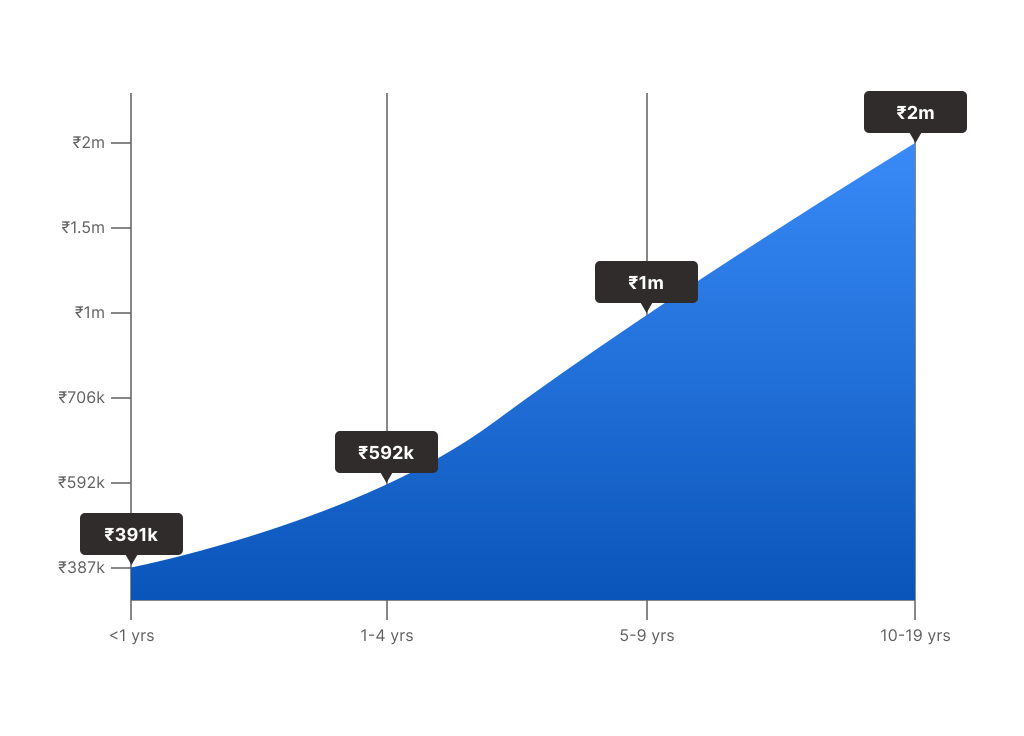
Key Takeaways: The biggest salary jump occurs between mid-level and senior roles, often representing 60-100% increases. Specialized expertise in high-demand areas like microservices architecture or cloud infrastructure accelerates this growth.
Full Stack vs. Specialized Roles: A Quick Salary Comparison
While Full Stack developers are highly versatile, specialized roles sometimes command distinct salary brackets, particularly at the senior level where deep expertise is valued.
| Role |
Average Entry-Level Salary (INR) |
Average Senior-Level Salary (INR) |
Key Value Proposition |
| Full Stack Developer |
₹5.1 LPA - ₹7 LPA |
₹16 LPA - ₹30 LPA+ |
Versatility; End-to-end project ownership. |
| Back-End Developer |
₹6.5 LPA - ₹8 LPA |
₹18 LPA - ₹35 LPA+ |
Deep server-side, database, and system architecture expertise. |
| Front-End Developer |
₹4.5 LPA - ₹6 LPA |
₹15 LPA - ₹28 LPA+ |
Expertise in UI/UX, accessibility, and modern client-side frameworks. |
Note: Back-End roles, due to their complexity with server infrastructure and databases, often have a slightly higher potential ceiling in major product companies, while Full Stack remains the most balanced and in-demand role.
What Skills are Required to be a Full Stack Developer?
In today's job market, professionals with full stack development are in high demand. They work on the front-end, back-end, databases, and APIs. Having versatility with languages like JavaScript, Python, and Java frameworks like React, Node.js, and Django and skills in testing, security, and learning new technologies is key. These full stack developer skills allow them to build an entire feature or product from start to finish. Let's explore more about this skills.
Technical Skills
- Efficiency in Programming Languages: Needless to say, proficiency in leading programming languages like Python, HTML, CSS, C, or Javascript is necessary to get started with full stack development.
- Front end technologies: In order to work on front end development, technologies such as Angular, Bootstrap, Flutter, Vue.js and NPM are necessary to learn.
- Back end technologies: Since the role of a full stack developer also comprises developing and managing back end systems, knowledge of Ruby, Laravel, PHP, Spring and more is highly preferred.
- Database Management: Full stack developers are responsible for harnessing relational and NoSQL technologies to design and develop databases.
- Version Control: Full stack developers are frequently required to work with version control systems like Git, enabling smooth collaboration while keeping track of all the changes implemented.
- User Experience (UX): Full stack developers also need to cultivate a user experience skills to work on the visual aspects of an application or website. This may include proficiency in user research, information structure, wireframing and more.
Soft Skills
- Time management: Since developers have to manage a bunch of tasks simultaneously, time management skills are essential to adhere to deadlines, ensure quality, allocate resources as well as ensure overall productivity.
- Problem-solving abilities: Developers are bound to reach complicated dead-ends when working on extensive projects. Inheriting problem-solving abilities is a significant part of must-have soft skills for full stack developers.
- Communication: In order to maintain a smooth workflow across different organisational components, developers need to hone communication skills, enabling all organs to function effectively. From sharing different perspectives on a project with non-technical teammates easily to active participation in discussions with stakeholders, full stack developers must inculcate effective communication skills to manage it all.
- Collaboration: An extensive project cannot be worked upon individually. A team of skilled professionals from different disciplines are required to collaborate and bring a project to successful completion. Collaboration skills, therefore, are another addition a full stack developer must bring to their resume.
Future Trends: Skills to Master Beyond 2025
To maintain a competitive edge and secure the highest salary packages, full stack developers must proactively embrace the following emerging trends in the Indian tech market:
- AI-Driven Development Tools: Mastering tools like GitHub Copilot and understanding AI-powered code generation is becoming a core competency for efficiency.
- Cloud-Native & Serverless Architecture: Deep knowledge of cloud platforms (especially AWS, Azure, and Google Cloud) and the ability to deploy using serverless functions (e.g., AWS Lambda) and microservices (Docker/Kubernetes) is critical for large-scale applications.
- DevSecOps Integration: Security is shifting left. Developers are now expected to integrate security practices (DevSecOps) into every stage of the development pipeline to build secure-by-design applications.
- Progressive Web Apps (PWAs): The demand for fast, reliable, and installable web applications that bridge the gap between web and native apps is growing, requiring expertise in PWA fundamentals.
- Specialized JavaScript Stacks: The MERN (MongoDB, Express, React, Node.js) and MEAN (MongoDB, Express, Angular, Node.js) stacks continue their dominance, making specialized expertise in these ecosystems highly valuable, often integrating newer tools like Next.js for server-side rendering.
Additional Opportunities for Full Stack Developers
Aside from a competitive salary, full stack developers in India have the opportunity to expand into several other streams of income and the growth of their profession. The varied skills needed for such a position make it possible to have extra work, freelancing, and continuous learning, which can greatly increase the income as well as the career progression.
Side Hustles and Additional Income Streams
A full stack developer is a person who is capable of making a side job due to their skillfulness in both front-end and back-end technologies. Some experts partially cover the primary income through:
- Freelance Basis Projects: Developers can work on client-driven projects from all over the world using platforms such as Upwork and Toptal. As a result, they can get higher rates for their specialized skills, such as JavaScript, e-commerce solutions, or finance-related web applications, more often.
- Entrepreneurship: Developers can leverage their expertise to launch their own products or digital assets—such as apps, SaaS tools, or e-commerce sites—that generate passive income.
- Educational Content Creation: Creating blogs, YouTube tutorials, podcasts, or even online courses (for example, on topics like “Introduction to Web Development with HTML, CSS, and JavaScript”) can provide steady additional income streams.
- Affiliate Marketing and Bug Bounty Programs: Promoting tech products or participating in security testing for companies can yield bonuses and rewards.
Stock Options and Bonuses: Working for startups or large tech firms sometimes comes with additional financial perks like stock options or performance-based bonuses.
Conclusion and Action Steps
Full stack developer salaries in India is stable and profitable opportunity where the developer's income will rise gradually. The reason to be successful in these kinds of work is to use your time wisely developing skills, learning continuously, and making smart career decisions.
Why It Matters in 2025: Remote work democracy means that talented Indian developers are able to take up positions anywhere in the world and still be living in India. The companies, however, are increasingly giving priority to measurable skills over degrees; this change is creating opportunities for developers who have taught themselves and those who have unusual backgrounds
Practical Steps for Maximizing Earnings:
- Attempt to master 2-3 high-demand technologies rather than having superficial knowledge of many
- Develop a portfolio of 3-5 substantial projects that you have worked on which highlights your ability to solve the problems in the real world
- Change your company intentionally every 2-3 years for bringing about a desirable salary increment
- Work on your communication skills with vigour that will open the door to senior and leadership positions
- Pick a remote job at an international company and you will be earning several times more than now
- Keep yourself updated with the newest technologies by taking up continuous learning
Realistic Career Timeline: Entry-level positions may start modestly at ₹4-6 lakhs, but strategic skill development and smart career moves can lead to ₹25-40+ lakhs within 8-10 years. The path requires dedication, continuous learning, adaptability, and strategic decisions about skills, companies, and opportunities.
Frequently Asked Questions
1. How much does a Full Stack Developer earn in India?
On average, a full stack developer in India earns around INR 7 to INR 16 LPA if they are in the early stages of working. On the other hand, with experience, this figure can go up, reaching INR 14 LPA or even INR 30 LPA.
2. Is Full Stack Developer a good career in India?
Full stack developer is a booming career in India among tech enthusiasts aiming to explore diverse technologies. Both national and multinational companies are on the lookout for skilled full stack developers, and India is one of the major hubs. Following the growing demand, more aspirants are aiming to choose full stack development as their career, making it a successful career in India.
3. Is it hard to become a Full Stack Developer?
Just as hard as any STEM career can get, full stack development does require a diverse skill set and experience, which can take years to obtain. However, the career is equally rewarding, further motivating aspirants to go for it!
4. Can a fresher learn full stack?
Yes, freshers can learn full stack development and kickstart a successful career as full stack developers by acquiring front end and back end skills. Leveraging online resources or getting enrolled in offline courses can help you navigate the journey of full stack development from a fresher to a seasoned developer.





.avif)


