Step-by-Step Explanation
Here is a step-by-step process of how the backtracking works:
1. Start from an Initial State
We begin with an empty or partially completed solution and define constraints that must be followed.
2. Exploration: Make a Choice and Move Forward
At each step, we choose an option from a set of possible choices and add it to our current solution.
3. Check if the Current Choice Leads to a Solution
If the current choice completes the solution (i.e., meets all constraints), we return it as a valid solution.
4. Backtracking: If the Choice Leads to an Invalid State, Backtrack
If we find that the choice violates the constraints, we undo (remove) that choice and go back to the previous step to try another option.
5. Repeat Until All Possibilities are Explored
This process continues recursively, exploring all possible paths until we find all valid solutions or confirm that no solution exists.
Example: Solving a Maze Using Backtracking
Imagine a rat trying to find its way out of a maze. The rat can move left, right, up, or down, but cannot pass through walls.
- The rat starts at the entry point.
- It picks a direction and moves forward.
- If it reaches a dead-end (wall or visited cell), it backtracks to the last valid position and tries a different direction.
- If it finds the exit, the solution is complete.
- If all paths have been tried and none lead to the exit, then the maze is unsolvable.
This trial-and-error process is exactly how backtracking works in algorithmic problem-solving.
Components of Backtracking Algorithm
Backtracking algorithms consist of several essential components that help in efficiently exploring possible solutions while eliminating invalid ones. The key components include:
1. State Space or Decision Tree
- Represents all possible configurations or solutions that can be explored.
- For example, in the N-Queens problem, each arrangement of queens on the board is a state.
2. Choice Function
- Determines the set of valid options available at each step.
- For example, in a maze-solving problem, the choices are moving up, down, left, or right.
3. Constraints
- Rules that must be satisfied for a solution to be valid.
- In Sudoku, a constraint is that no number should repeat in a row, column, or sub-grid.
4. Solution Check
- A function that verifies whether the current state forms a complete and valid solution.
- In the 4-Queens problem, a solution check ensures that no two queens attack each other.
5. Backtracking Mechanism
- If a solution does not meet the constraints, the algorithm undoes the last step and tries an alternative choice.
- This helps in systematically exploring all possible paths while discarding invalid ones.
Features of Backtracking
- Recursive in Nature
Backtracking relies on recursive function calls to explore different possibilities. Each call represents a decision point in the solution path. - Step-by-Step Solution Building
Solutions are constructed one step at a time, checking for validity at each stage. This ensures that only correct paths are explored further. - Backtracking on Failure
If a chosen path leads to an invalid solution, the algorithm undoes the last step. It then tries the next possible option, moving backward to move forward. - Efficient Pruning of Unnecessary Paths
Backtracking skips over paths that are guaranteed to fail early on. This reduces time complexity by avoiding useless exploration. - Ideal for Constraint-Based Problems
It works well for problems with strict rules, like puzzles or optimization tasks. Backtracking checks constraints at every step to ensure correctness.
Types of Backtracking Algorithms
Backtracking is a systematic process for resolving computing issues by considering every possible solution. It gradually develops potential solutions and drops a candidate ("backtracks") as soon as it concludes that the candidate is not likely to result in a workable solution. There are two primary techniques for implementing backtracking algorithms: recursive and non-recursive.
1. Recursive Backtracking Algorithm
In recursive backtracking, the algorithm calls itself with modified parameters to explore potential solutions. This self-referential approach utilizes the system's call stack to manage the sequence of choices and states.
How it works
- Base Case: Define a condition that terminates the recursion, such as finding a valid solution or reaching an unsolvable state.
- Recursive Exploration: For each available option from the current state:
- Apply the option and make a recursive call to explore further.
- If a valid solution is found in the recursive call, return it.
- If not, undo the current move (backtrack) and attempt the next option.
Example: N-Queens Problem
The N-Queens problem requires placing N queens on an N×N chessboard so that no two queens threaten each other. A recursive backtracking solution places a queen in a row and recursively attempts to place queens in subsequent rows, backtracking upon encountering conflicts.
2. Non-Recursive Backtracking Algorithm
Non-recursive backtracking manages the exploration process explicitly using data structures like stacks or queues, avoiding the use of the system's call stack.
How it works
- Initialization: Set up a stack to keep track of the current state and decisions made.
- Iterative Exploration: While there are states to explore:
- Retrieve the current state from the stack.
- Generate all possible options from this state.
- For each option:
- If it leads to a solution, record it.
- If it's a valid intermediate state, push it onto the stack for further exploration.
Example: Iterative Maze Solver
In solving a maze, a non-recursive backtracking algorithm uses a stack to track the current position and path. At each step, it explores unvisited neighboring cells, pushes the current state onto the stack, and moves to the next cell. Upon reaching a dead-end, it backtracks by popping the previous state from the stack and trying a different path.
Difference Between Recursive and Non-Recursive Approaches
Here's a comparison table outlining key differences between recursive and non-recursive (iterative) approaches:
| Factor |
Recursive Approach |
Non-Recursive (Iterative) Approach |
| Code Readability |
Generally more concise and elegant |
Typically more verbose but straightforward |
| Memory Usage |
Uses stack memory (risk of stack overflow) |
Uses constant memory (no stack overhead) |
| Performance |
Slower due to function call overhead |
Faster with no function call overhead |
| Problem Suitability |
Best for naturally recursive problems (e.g., tree traversals) |
Better for simple looping tasks |
| Debugging |
Harder to debug due to nested calls |
Easier to debug with linear execution |
| Implementation |
Requires base case and recursive case |
Uses loops (for/while) with explicit state |
Applications of Backtracking in DAA
Backtracking is a method of problem-solving that gradually advances candidates to solutions and drops a candidate ("backtracks") as soon as it concludes that the candidate is not likely to be finished with a workable solution. This approach is particularly effective for solving combinatorial problems where a sequence of choices leads to a solution. Below are detailed explanations of several classic problems that utilize backtracking:
1. N-Queens Problem
Problem Statement
Place 4 queens on a 4×4 chessboard so that no two queens occupy the same row, column, or diagonal.
The N-Queens problem is a classic example of combinatorial optimization and backtracking algorithms. The goal is to place N queens on an N×N chessboard without any two queens attacking each other by ensuring they are not in the same row, column, or diagonal. For N=4, the challenge is to position 4 queens on a 4×4 board under these constraints.
Approach
We can solve this problem using a backtracking algorithm, which involves placing queens in one row at a time and backtracking whenever a conflict arises.
Algorithm Implementation
The backtracking algorithm can be implemented as follows:
1. Start in the Leftmost Column
- Begin placing queens from the first column.
2. Place Queens Column by Column
- For each column, attempt to place a queen in a row that doesn't conflict with previously placed queens.
3. Check for Conflicts
- Before placing a queen, ensure that no other queen is in the same row or on the same diagonal.
4. Recursive Exploration
- After placing a queen, move to the next column and repeat the process.
5. Backtrack When Necessary
- If placing a queen in a column leads to conflicts in all rows, backtrack to the previous column and move the queen to the next available row.
6. Repeat Until Solution is Found
- Continue this process until all queens are placed without conflicts.
This method systematically explores all possible placements and backtracks whenever a conflict is detected, ensuring that all potential solutions are examined.
The 4-Queens problem illustrates the power of backtracking algorithms in solving combinatorial challenges. By exploring possible configurations and backtracking upon encountering conflicts, we can find all valid arrangements for placing queens on the board.
Here's a visual representation of the solution:
In this arrangement:
- The first queen is placed in the second column of the first row.
- The second queen can be found in the fourth column of the 2nd row.
- The third queen occupies the first column of the third row.
- The fourth queen is positioned in the third column of the fourth row.
This configuration ensures that no two queens share the same row, column, or diagonal.
Pseudocode for N-Queens Problem Using Backtracking
Function SolveNQueens(N):
    Create a board of size N x N and initialize all cells to 0
    Call PlaceQueen(board, column = 0)

Function PlaceQueen(board, column):
    If column ≥ N:
        Print the board as a valid solution
        Return

    For each row from 0 to N - 1:
        If placing a queen at (row, column) is safe:
            Place queen at (row, column)
            Recursively call PlaceQueen(board, column + 1)
            Remove the queen from (row, column) [Backtrack]

Function IsSafe(board, row, column):
    Check the row on the left side
    Check the upper diagonal on the left side
    Check the lower diagonal on the left side
    If no threats found:
        Return True
    Else:
        Return False
C++ Code for N-Queens Problem Using Backtracking
#include <iostream>
using namespace std;

#define N 4

// Function to print the board configuration
void printSolution(int board[N][N]) {
    for (int i = 0; i < N; i++) {
        for (int j = 0; j < N; j++)
            cout << board[i][j] << " ";
        cout << endl;
    }
    cout << endl;
}

// Function to check if placing a queen at board[row][col] is safe
bool isSafe(int board[N][N], int row, int col) {
    int i, j;

    // Check left side of the current row
    for (i = 0; i < col; i++)
        if (board[row][i])
            return false;

    // Check upper diagonal on left side
    for (i = row, j = col; i >= 0 && j >= 0; i--, j--)
        if (board[i][j])
            return false;

    // Check lower diagonal on left side
    for (i = row, j = col; j >= 0 && i < N; i++, j--)
        if (board[i][j])
            return false;

    return true;
}

// Recursive function to solve N-Queens problem
bool solveNQUtil(int board[N][N], int col) {
    // If all queens are placed, return true
    if (col >= N) {
        printSolution(board);
        return true;
    }

    bool res = false;
    // Try placing queen in each row of the current column
    for (int i = 0; i < N; i++) {
        if (isSafe(board, i, col)) {
            // Place the queen
            board[i][col] = 1;

            // Recur to place the rest of the queens
            res = solveNQUtil(board, col + 1) || res;

            // Backtrack: Remove queen from board[i][col]
            board[i][col] = 0;
        }
    }

    return res;
}

// Function to solve N-Queens problem
void solveNQ() {
    int board[N][N] = {0};

    if (!solveNQUtil(board, 0)) {
        cout << "Solution does not exist" << endl;
        return;
    }
}

int main() {
    solveNQ();
    return 0;
}
Explanation
- printSolution() Function:
- Displays the current arrangement of the chessboard.
- 1 represents a queen, and 0 represents a space.
- isSafe() Function:
- Checks if a queen can be placed in the given row and column.
- Ensures that no other queen is in the same row, upper diagonal, or lower diagonal.
- solveNQUtil() Function:
- This is a recursive function that attempts to place queens column by column.
- If a queen can be placed safely, it proceeds to place the next queen in the next column.
- If no safe position is found, it backtracks by removing the last placed queen and tries a different position.
- solveNQ() Function:
- Initializes the board and calls solveNQUtil() to find and print all possible solutions.
- main() Function:
- Calls solveNQ() to solve the problem.
Output
The program prints all possible solutions for N = 4:
0 1 0 0
0 0 0 1
1 0 0 0
0 0 1 0

0 0 1 0
1 0 0 0
0 0 0 1
0 1 0 0
2. Sudoku Solver
Sudoku is a 9×9 grid puzzle where the goal is to fill the grid so that each row, column, and each of the nine 3×3 subgrids contain all digits from 1 to 9 without repetition.
Backtracking Approach: The solver fills empty cells one by one, trying digits from 1 to 9. After placing a digit, it moves to the next empty cell. If placing a particular digit violates Sudoku rules, the algorithm backtracks to the previous cell and tries the next possible digit. This process repeats until the puzzle is solved.
Pseudocode for Sudoku Solver using Backtracking
function solveSudoku(board):
    if no empty cell:
        return true
    for digit = 1 to 9:
        if placing digit is valid:
            place digit
            if solveSudoku(board) == true:
                return true
            remove digit (backtrack)
    return false
3. Hamiltonian Path & Cycle
In a graph, a Hamiltonian Path makes exactly one visit to every vertex. A Hamiltonian Cycle is a Hamiltonian Path that starts and ends at the same vertex, forming a cycle.
Backtracking Approach: The algorithm starts at a vertex and explores all adjacent vertices. It recursively continues the process, marking vertices as visited. If it reaches a point where no unvisited adjacent vertices are available, and not all vertices are visited, it backtracks to the previous vertex and tries a different path. This continues until a Hamiltonian Path or Cycle is found or all possibilities are exhausted.
Pseudo code for Hamiltonian Path & Cycle using Backtracking
function hamiltonianPath(graph, path, vertex):
    if all vertices are visited:
        return true
    for each adjacent vertex:
        if vertex is not visited:
            add vertex to path
            if hamiltonianPath(graph, path, next vertex) == true:
                return true
            remove vertex from path (backtrack)
    return false
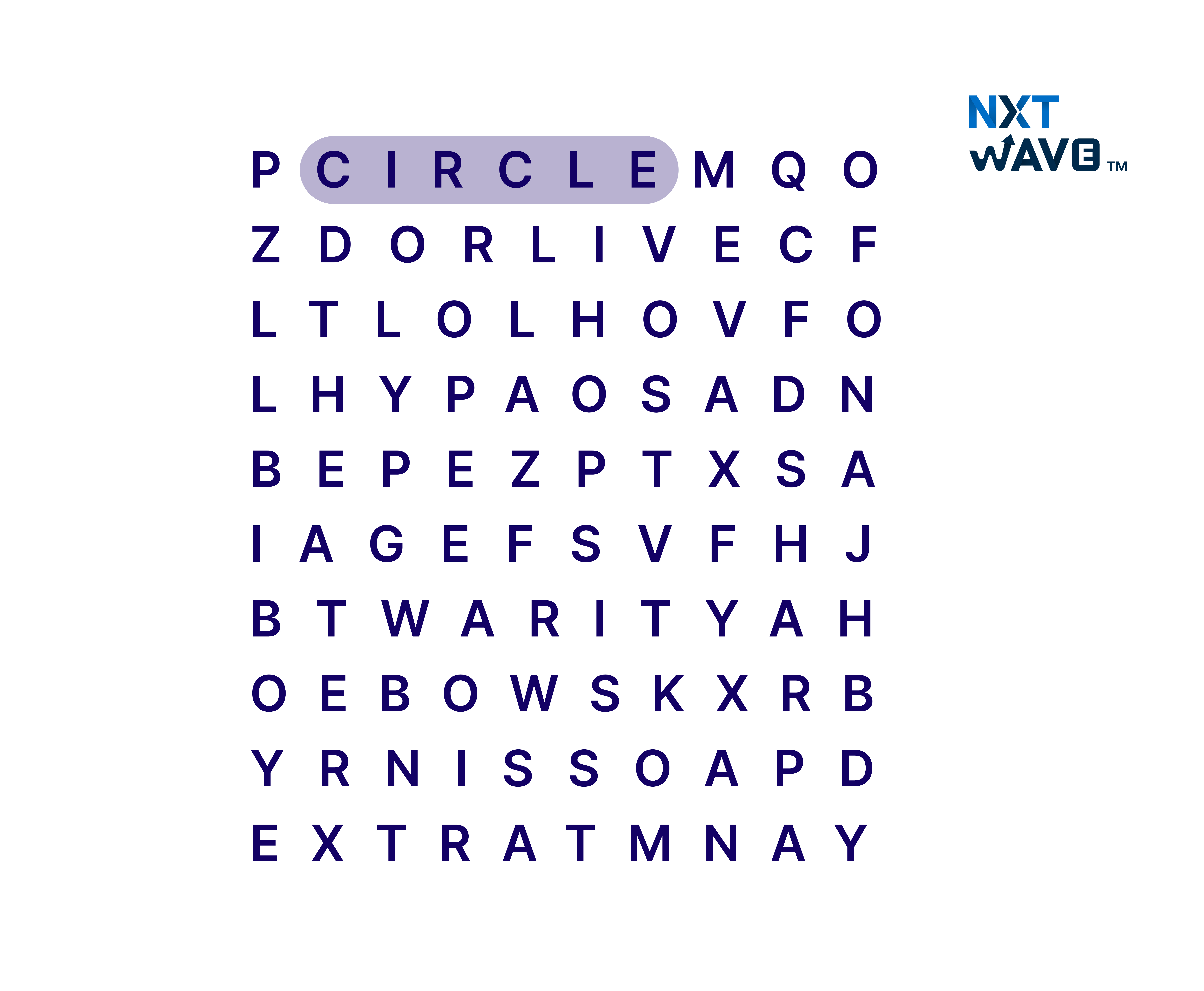
4. Word Search
The objective is to figure out whether a word exists in a 2D grid of letters. Letters from the following cells can be united to create the word; "adjacent" cells belong to those that are horizontally or vertically adjacent to one another.
Backtracking Approach: The algorithm starts from each cell and explores all possible directions (up, down, left, right) to find the first letter of the word. Upon finding the first letter, it recursively searches for the next letters in adjacent cells. If a path does not lead to the complete word, it backtracks and tries a different path. This process continues until the word is found or all starting points are exhausted.
Pseudo code for Word Search using Backtracking
function wordSearch(board, word, i, j, index):
    if index == length of word:
        return true
    if i < 0 or j < 0 or i >= board size or j >= board size:
        return false
    if board[i][j] != word[index]:
        return false

    mark board[i][j] as visited
    for each direction (up, down, left, right):
        if wordSearch(board, word, new_i, new_j, index + 1):
            return true
    unmark board[i][j] (backtrack)
    return false
5. Graph Coloring
Graph coloring assigns colors to each vertex of a graph such that no two adjacent vertices share the same color. The goal is to use the minimum number of colors while satisfying this constraint. It has real-world applications in tasks like exam scheduling, map coloring, and resource allocation.
Backtracking Approach
The algorithm tries to assign a color to each vertex, one at a time, ensuring that adjacent vertices do not share the same color. It starts with the first vertex and recursively attempts to color the remaining vertices. If at any point no valid color is available for a vertex, it backtracks to the previous vertex and tries a different color.
Pseudo-code for Graph Coloring Using Backtracking
Function GraphColoring(graph, colors, vertex, totalVertices):
    If vertex equals totalVertices:
        Return True  // All vertices are successfully colored

    For each color from 1 to number of available colors:
        If IsSafe(graph, colors, vertex, color) is True:
            Assign 'color' to current 'vertex'
            If GraphColoring(graph, colors, vertex + 1, totalVertices) is True:
                Return True  // Proceed with next vertex
            Remove color assignment (backtrack)

    Return False  // No valid color found for this vertex

Function IsSafe(graph, colors, vertex, color):
    For each vertex adjacent to the current vertex:
        If that adjacent vertex already has the same 'color':
            Return False  // Not safe to use this color

    Return True  // Safe to use the color
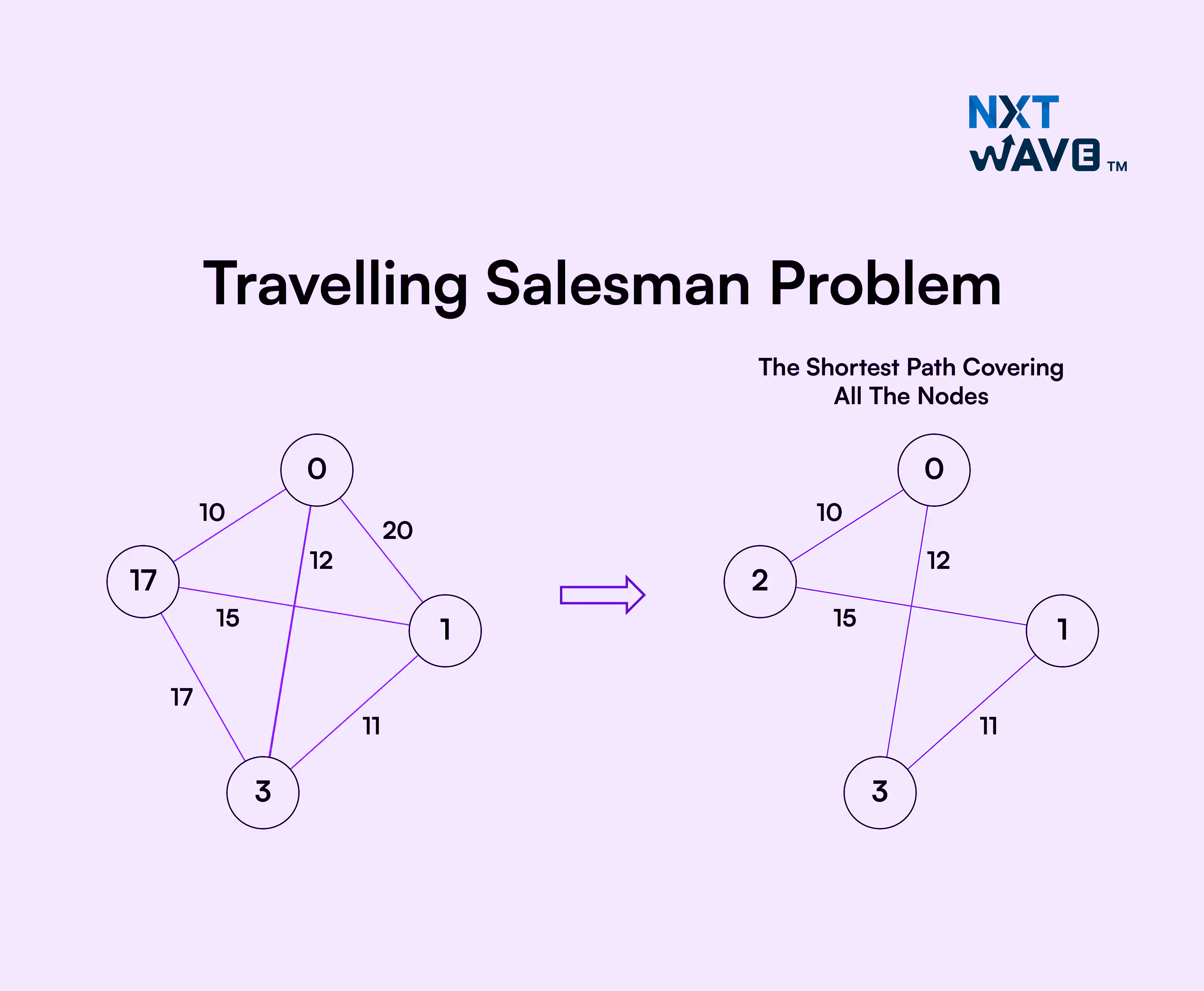
6. Traveling Salesman Problem (TSP)
The TSP seeks to identify the quickest path that makes precisely one stop in each city before returning to the starting location. It’s a classic optimization problem with applications in logistics, route planning, and DNA sequencing.
Backtracking Approach
The algorithm generates all permutations of the cities, calculating the path length of each. If at any point the current path's cost exceeds the minimum found so far, the algorithm prunes that path and backtracks to explore a different route. Though this guarantees finding the optimal solution, it's computationally expensive for large input sizes.
Pseudocode for Traveling Salesman Problem Using Backtracking
FUNCTION TSP(currentCity, visitedCities, currentCost):
    IF all cities are visited AND there's a path back to the starting city:
        UPDATE minimumCost if currentCost is less than minimumCost
        RETURN

    FOR each unvisited city i:
        IF there's a path from currentCity to city i:
            MARK city i as visited
            CALL TSP(city i, visitedCities, currentCost + cost[currentCity][i])
            UNMARK city i as visited (Backtrack)
Constraint Satisfaction Problems (CSPs)
CSPs are mathematical problems defined by a set of objects whose state must satisfy several constraints or conditions. Examples include map coloring, job scheduling, and N-Queens.
Backtracking Approach
The algorithm assigns values to variables one by one. After each assignment, it checks whether the constraints are still satisfied. If not, it backtracks to the previous variable and tries a different value. This ensures an exhaustive yet efficient search of the solution space, especially when integrated with forward-checking or constraint propagation techniques.
Methods to Implement Backtracking in DAA
Backtracking can be implemented in different ways depending on the complexity and efficiency needed. Below are three approaches:
- Naïve Approach: Generating all permutations using recursion.
- Expected Approach: Using backtracking with pruning.
- Alternate Approach: Backtracking using bit-masking.
1. Naïve Approach: Generating All Permutations Using Recursion
This method works by trying out every possible way to arrange a set of elements. It goes step by step, checking all possible orders without worrying about whether they make sense or are the best choice. Because it looks at every single possibility, it can take a long time if there are many elements to arrange.
Algorithm
1. Input: A collection of distinct elements.
2. Base Case: If the collection is empty, return an empty permutation.
3. Recursive Case: For each element in the collection:
- Remove the element from the collection.
- Generate all permutations of the remaining elements recursively.
- Prepend the removed element to each of these permutations.
4. Output: All possible permutations of the input collection.
Pseudocode for Generating All Permutations Using Recursion
FUNCTION generatePermutations(nums, start):
    IF start == size of nums - 1 THEN:
        PRINT nums
        RETURN

    FOR i FROM start TO size of nums - 1 DO:
        SWAP nums[start] WITH nums[i]
        CALL generatePermutations(nums, start + 1)
        SWAP nums[start] WITH nums[i] // BACKTRACK

FUNCTION main():
    INITIALIZE nums = [1, 2, 3]
    CALL generatePermutations(nums, 0)
C++ Code
#include <iostream>
#include <vector>
#include <algorithm>

void generatePermutations(std::vector<int>& nums, int start) {
    if (start == nums.size() - 1) {
        for (int num : nums) {
            std::cout << num << " ";
        }
        std::cout << std::endl;
        return;
    }
    for (int i = start; i < nums.size(); ++i) {
        std::swap(nums[start], nums[i]);
        generatePermutations(nums, start + 1);
        std::swap(nums[start], nums[i]); // Backtrack
    }
}

int main() {
    std::vector<int> nums = {1, 2, 3};
    generatePermutations(nums, 0);
    return 0;
}
Explanation
- Function generatePermutations: This function takes a vector nums and an integer start representing the starting index for generating permutations.
- Base Case: If start reaches the last index, it prints the current permutation.
- Recursive Case: It iterates over the elements from the start index to the end, swapping the current element with the element at the start index, recursively generating permutations for the remaining elements, and then backtracking by swapping the elements back to their original positions.
- Function main: Initializes vector nums with elements {1, 2, 3} and calls generatePermutations starting from index 0.
Output
1 2 3
1 3 2
2 1 3
2 3 1
3 2 1
3 1 2
2. Expected Approach: Using Backtracking with Pruning
Backtracking with pruning enhances the basic backtracking approach by eliminating paths that cannot lead to a valid solution, thereby reducing the search space and improving efficiency. Pruning involves adding constraints to avoid exploring unnecessary branches in the solution space.
Algorithm
1. Input: A problem with a defined solution space and constraints.
2. Recursive Exploration: Explore possible decisions at each step.
- Before diving deeper into a particular path, check if it satisfies the problem's constraints.
- If a path violates any constraint, prune it by backtracking immediately without further exploration.
3. Base Case: If a valid solution is found, record or output it.
4. Backtrack: Undo the last decision and explore alternative paths.
5. Output: All valid solutions that satisfy the problem's constraints.
Pseudocode for Backtracking with Pruning
FUNCTION isValid(solution):
    // Check if the current solution satisfies the problem constraints
    RETURN true  // Placeholder, replace with actual validation logic

FUNCTION backtrackWithPruning(solution, step, n):
    IF step == n THEN:
        IF isValid(solution) THEN:
            PRINT solution
        RETURN

    FOR i FROM 1 TO n DO:
        solution[step] = i
        IF isValid(solution) THEN:
            CALL backtrackWithPruning(solution, step + 1, n)

FUNCTION main():
    INITIALIZE n = 3 // Example problem size
    INITIALIZE solution as an array of size n
    CALL backtrackWithPruning(solution, 0, n)
C++ Code for Backtracking with Pruning
#include <iostream>
#include <vector>

bool isValid(const std::vector<int>& solution) {
    // Implement constraint checks specific to the problem
    return true; // Placeholder: Replace with actual validation logic
}

void backtrackWithPruning(std::vector<int>& solution, int step, int n) {
    if (step == n) {
        if (isValid(solution)) {
            for (int num : solution) {
                std::cout << num << " ";
            }
            std::cout << std::endl;
        }
        return;
    }
    for (int i = 1; i <= n; ++i) {
        solution[step] = i;
        if (isValid(solution)) {
            backtrackWithPruning(solution, step + 1, n);
        }
        // No need to undo the assignment; it will be overwritten in the next iteration
    }
}

int main() {
    int n = 3; // Example problem size
    std::vector<int> solution(n);
    backtrackWithPruning(solution, 0, n);
    return 0;
}
Explanation
- Function isValid: Checks if the current partial solution satisfies all problem-specific constraints. This function should be implemented based on the specific problem requirements.
- Function backtrackWithPruning: Manages the recursive exploration of possible solutions.
- Base Case: If step equals n (indicating a complete solution), it validates and prints the solution if it's valid.
- Recursive Case: Iterates over possible values, assigns one to the current step, checks validity, and recursively proceeds to the next step if valid.
- Function main: Initializes the problem size n and the solution vector, then calls backtrackWithPruning starting from step 0.
Output
1 1 1
1 1 2
1 1 3
1 2 1
1 2 2
1 2 3
1 3 1
1 3 2
1 3 3
2 1 1
2 1 2
2 1 3
2 2 1
2 2 2
2 2 3
2 3 1
2 3 2
2 3 3
3 1 1
3 1 2
3 1 3
3 2 1
3 2 2
3 2 3
3 3 1
3 3 2
3 3 3
3. Alternate Approach: Backtracking Using Bit-Masking
Bit-masking is a technique that utilizes the binary representation of numbers to manipulate individual bits efficiently. In backtracking, bit-masking can be employed to represent the state of elements (e.g., whether an element is included in a subset or has been visited) using bits of an integer. This approach is particularly useful when dealing with problems involving sets or combinations, as it allows for efficient state representation and manipulation.
Algorithm
- Input: A set of n elements.
- Representation: Use an integer (or an array of integers for larger sets) where each bit represents the inclusion (1) or exclusion (0) of the corresponding element in a subset.
- Iteration: Iterate over all possible combinations by generating numbers from 0 to 2^n - 1. Each number's binary representation serves as a mask indicating the elements included in the current subset.
- Subset Generation: For each generated number (mask), include elements corresponding to set bits (bits set to 1) in the subset.
- Output: All possible subsets of the input set.
Pseudocode for Generating Subsets Using Bit Masking
FUNCTION generateSubsets(set):
    n ← size of set
    totalSubsets ← 2^n  // Total number of subsets

    FOR mask FROM 0 TO totalSubsets - 1 DO:
        subset ← empty list

        FOR i FROM 0 TO n - 1 DO:
            IF (mask AND (1 << i)) is TRUE THEN:
                ADD set[i] to subset

        PRINT subset

FUNCTION main():
    set ← [1, 2, 3]  // Example set
    CALL generateSubsets(set)
C++ Code for Generating Subsets Using Bit Masking
#include <iostream>
#include <vector>

void generateSubsets(const std::vector<int>& set) {
    int n = set.size();
    int totalSubsets = 1 << n; // 2^n subsets

    for (int mask = 0; mask < totalSubsets; ++mask) {
        std::vector<int> subset;
        for (int i = 0; i < n; ++i) {
            if (mask & (1 << i)) {
                subset.push_back(set[i]);
            }
        }
        // Output the current subset
        std::cout << "{ ";
        for (int num : subset) {
            std::cout << num << " ";
        }
        std::cout << "}" << std::endl;
    }
}

int main() {
    std::vector<int> set = {1, 2, 3};
    generateSubsets(set);
    return 0;
}
Explanation
The generateSubsets() function prints all possible subsets of a set using bit manipulation. It calculates the total number of subsets using 1 << n, where n is the number of elements. For each number from 0 to 2^n - 1, it checks the binary representation to decide which elements to include in the current subset. If a bit at position i is set, it adds the corresponding element to the subset and prints it using a simple loop. The main function runs this logic for the input set {1, 2, 3}.
Output
{ }
{ 1 }
{ 2 }
{ 1 2 }
{ 3 }
{ 1 3 }
{ 2 3 }
{ 1 2 3 }
This output represents all possible subsets of the set {1, 2, 3}, including the empty set.
By applying bit-masking in backtracking, we achieve an efficient and concise method for generating subsets or combinations, which is especially beneficial when dealing with problems involving a relatively small number of elements due to the exponential growth of possible subsets.
How is Backtracking Different from Recursion?
Backtracking is a specialized form of recursion, but it differs in how it explores and solves problems. Here's a comparison:
| Feature |
Recursion |
Backtracking |
| Definition |
A method where a function calls itself to solve a problem. |
A specialized form of recursion used to explore all possible solutions and revert when a path is invalid. |
| Approach |
Solves problems by breaking them into smaller subproblems. |
Tries out all possible solutions and backtracks when a solution fails. |
| Exploration |
Explores all paths without necessarily reversing steps. |
Explores one path at a time and reverses (backtracks) if needed. |
| Usage |
Used for problems like factorial, Fibonacci, and tree traversals. |
Used for solving constraint-based problems like Sudoku, N-Queens, and maze solving. |
| Efficiency |
It may be inefficient if it explores unnecessary branches. |
More efficient as it prunes branches that don't lead to a solution. |
| Backtracking Mechanism |
Does not necessarily undo previous steps. |
Explicitly undoes previous choices when a solution path fails. |
| Example Problem |
Computing Fibonacci numbers using recursion. |
Solving a Sudoku puzzle by trying numbers and backtracking when needed. |
Advantages & Disadvantages of Backtracking in DAA
Here are the advantages and disadvantages of backtracking in DAA:
Advantages of Backtracking
Here are the advantages of Backtracking in DAA:
- Efficient for solving complex problems – Backtracking systematically eliminates invalid paths, reducing unnecessary computations.
- Reduces the number of possibilities to explore – By pruning infeasible solutions early, it avoids brute force searching.
- Ensures correctness with systematic exploration – It guarantees that all valid solutions are considered, making it a reliable approach.
- Applicable to a wide range of problems – Used in puzzles, optimization, and constraint satisfaction problems like Sudoku, N-Queens, and graph coloring.
- Finds multiple or optimal solutions – If needed, backtracking can find all possible solutions rather than stopping at the first valid one.
Disadvantages of Backtracking
Below are the disadvantages of backtracking:
- Can be slow for large problem sets: The worst-case time complexity is exponential (O(b^d)), making it inefficient for large inputs.
- High recursion depth may lead to a stack overflow: Since backtracking relies on recursion, deep recursion can cause memory issues.
- Inefficient for problems without clear constraints: If no pruning is possible, it may end up checking all possibilities, leading to poor performance.
- Requires careful implementation: A poorly designed backtracking algorithm can result in excessive computations or incorrect solutions.
- Not suitable for real-time applications: Due to its high time complexity, it may not be practical for scenarios requiring immediate responses.
Time Complexity for Common Backtracking Problems
The time complexity of backtracking algorithms varies:
| Problem |
Time Complexity (O(b^d)) |
Space Complexity |
| N-Queens Problem |
O(N!) (Factorial growth) |
O(N) (for recursion stack) |
| Sudoku Solver |
O(9^k) |
O(k) (for recursion stack) |
| Graph Coloring Problem |
O(m^N) |
O(N) (for recursion stack) |
| Subset Sum Problem |
O(2^N) (Exponential) |
O(N) (for recursion stack) |
| Word Search Puzzle |
O(4^L) |
O(L) (for recursion stack) |
| Maze Solving |
O(2^N) |
O(N) (for recursion stack) |
Conclusion
Backtracking in DAA is a fundamental technique that allows us to solve complex problems by exploring all possible solutions. Its recursive nature and ability to prune invalid paths make it a powerful tool for solving puzzles, optimization problems, and more. By understanding the backtracking algorithm, you can tackle a wide range of challenges in computer science and beyond.
Upskill Your Career with Advanced Software Skills in College
Explore ProgramFrequently Asked Questions
1. What is backtracking in algorithms?
Backtracking is a problem-solving technique used in programming where we try to build a solution step by step. If at any point we realize that the current path won't lead to a valid solution, we go back (backtrack) and try a different approach. This method is commonly used in solving puzzles, pathfinding, and optimization problems.
2. How does backtracking differ from dynamic programming?
While both are algorithmic techniques used to solve problems, backtracking involves exploring all potential solutions and backtracking upon reaching invalid states. In contrast, dynamic programming solves problems by breaking them down into simpler subproblems and storing the results to avoid redundant computations.
3. What are some common applications of backtracking algorithms?
Backtracking is commonly used in solving constraint satisfaction problems such as puzzles (e.g., Sudoku), combinatorial problems (e.g., generating permutations), and pathfinding problems (e.g., maze solving).
4. Can backtracking be used to solve the N-Queens problem?
Yes, backtracking is a common approach to solve the N-Queens problem by placing queens on a chessboard one by one and backtracking whenever a conflict arises.
5. How can the efficiency of a backtracking algorithm be improved?
The efficiency of backtracking algorithms can be improved by implementing strategies such as constraint propagation, forward checking, and using heuristics to decide the order of variable assignments.
6. What are the two types of backtracking?
The two main types of backtracking are:
- Explicit Backtracking – Systematically explores all possible solutions and backtracks upon failure.
- Implicit Backtracking – Uses constraints to prune the search space and avoid unnecessary computations.
7. What is the 4 Queens problem?
The 4 Queens problem is a variation of the N-Queens problem where four queens must be placed on a 4×4 chessboard so that no two queens attack each other. It is solved using backtracking by placing queens individually and undoing incorrect placements.
8. Why is it called backtracking?
It is called backtracking because the algorithm "tracks back" by undoing previous steps when it reaches an invalid state, allowing it to explore alternative solutions systematically.
9. Is backtracking DFS or BFS?
Backtracking follows the Depth-First Search (DFS) approach, as it deeply explores one branch of the solution space before backtracking and trying another branch.
10. What is an example of backtracking?
A common example of backtracking is solving a Sudoku puzzle, where numbers are placed step by step, and incorrect placements are undone when an invalid state is reached.
11. When to Use a Backtracking Algorithm?
Use backtracking when:
- The problem involves a sequence of choices.
- There are constraints to check at each step.
- The solution requires generating all possible configurations.
- Pruning can optimize performance.





.avif)