Google recruits through online applications, assessments, technical interviews, and HR rounds.
Freshers can apply via Google careers India, on-campus drives, or coding competitions.
Eligibility includes B.E/B.Tech, MCA, or relevant degrees with strong DSA and problem-solving skills.
Technical interviews test algorithms, system design, databases, and coding efficiency.
Google emphasizes cultural fit (“Googleyness”), communication, and teamwork.
Competitive salary packages and global opportunities make google jobs highly desirable.
Introduction
Google is a worldwide leader in technology, a trendsetter in AI, cloud computing, search engines, and the like. The products that are used by billions of people globally are a result of Google's innovation. Google, which is also renowned for its vibrant work atmosphere and emphasis on innovation, offers employees and new graduates a platform to work on projects that can make a significant difference in the world.
It is essential for applicants interested in working at Google to understand the hiring process. The corporation has a methodical hiring process, which it uses as a tool to gauge candidates' technical skills, problem-solving abilities, and cultural compatibility. If you are a recent graduate applying for a freshers position at Google, or a professional with years of experience, understanding the requirements, recruitment stages, and preparation steps can significantly increase your success rate.
This manual is a comprehensive source of information regarding the 2025 Google hiring process. It is a go-to resource that covers everything from the expectations for the role, and technical interviews to assessment rounds and preparation tips. No matter whether you are a fresh graduate or a seasoned professional, this hiring guide will assist you in navigating the process and allow you to take the proper steps to kick-start a career at Google.
About Google
Aspect
Details
Headquarters
Mountain View, California, USA
Founded
04 September 1998
Founders
Larry Page, Sergey Brin
CEO
Sundar Pichai
Global Employees
1,83,323
Annual Revenue
42.5 billion USD
Offices Worldwide
60 countries
Years of Excellence
27 years
Services Offered
Google app, Android, Pixel devices, Google Photos, Google Workspace, and Gemini on Chrome, with AI features.
Google is deeply committed to fostering a culture of belonging and advancing diversity and inclusion at every stage of its recruitment and employment practices. The company’s approach is guided by a robust Equal Employment Opportunity (EEO) policy and affirmative action initiatives designed to ensure fair treatment and equal representation in the workforce for all.
Google’s EEO Policy guarantees equal employment opportunity regardless of race, colour, religion, gender, sexual orientation, gender identity/expression, national origin, disability, age, genetic information, veteran status, marital status, or any other characteristic protected by law. Google is also proactive in considering candidates with criminal histories, consistent with legal requirements, to support fair access to employment.
To further its mission of inclusion, Google implements affirmative action programs and continuously works to eliminate workplace discrimination. The company’s hiring process is designed to remove bias and promote diversity, ensuring that everyone—regardless of background—has a fair chance to join and thrive at Google.
Google’s commitment extends beyond hiring. The company actively cultivates a culture of belonging, where employees from diverse backgrounds feel valued and empowered. Initiatives focus on disability inclusion, support for veterans, respect for diverse gender identities and expressions, and recognition of different marital statuses.
By prioritizing diversity and equal opportunity, Google not only strengthens its workforce representation but also drives innovation and creativity across teams. This inclusive approach makes Google a leader in building a fair, dynamic, and welcoming workplace for everyone.
Why Join Google?
Google is one of the most desirable workplaces in the world due to its innovation-driven culture and employee-first philosophy. Here’s why thousands of engineers dream of working at Google:
Work on World-Changing Technology: AI, Deep Learning, Quantum Computing, and Large-Scale Systems.
Most Positive Work Environment: Team spirit, flexible working conditions, and open communication.
Worldwide Prospects: Contribute to products that have a positive impact on billions of users globally.
Excellent Compensation: Salaries, bonuses, and stock options that lead the industry.
Learning & Development: You can learn from expert mentors, use world-class resources, and join internal career development programs.
Perks: Eating free, healthcare, mental wellness programs, hybrid work options, and much more.
Company Culture and Work Environment at Google
Google is a leader in the field of diversity and inclusion, sustaining a workplace culture that praises innovation, collaboration, and a shared sense of belonging. The company is not content to simply maintain a "culture fit." Still, it constantly looks for "culture add" individuals who bring new perspectives and values that elevate the organisation, rather than just fitting in. This notion of "Googleyness" is characterised by a combination of traits, including creativity, inquisitiveness, humility, and a helpful spirit.
At Google, teams are formed based on the functions they perform, and employees come from diverse educational and experiential backgrounds, which also means a diversity of thought within each team. This form of leadership gives rise to the concept of emergent leadership, where individuals, depending on their expertise and the project's needs, take the initiative to lead without necessarily holding a formal title. This kind of setting not only helps your personal development but also the success of the team.
Google's commitment to maintaining a culturally inclusive workplace is evident in its equal opportunity employment policies, which guarantee fairness and non-discrimination to all employees, regardless of their background. In addition, the company believes in striking a balance between work and life, and thus provides its employees with the flexibility of working hours and a blended work model, which is conducive to both working from home and in the office.
Moreover, to keep their employees comfortable and stress-free, Google takes care of them through an assortment of employee perks and benefits, such as:
Health clubs and wellness activities that encourage physical health.
Challenging and at the same time, quality meal options at affordable-priced cafeterias
Extensive family care support programs through parental leave.
Performance bonuses and attractive compensation plans that are aligned with the employee’s contribution and job accomplishments.
Comprising these reimbursement proposals alongside career advancement and personal growth options in an energetic and caring culture, Google becomes a dream workplace for efficient professionals.
Google Jobs for Freshers & Professionals in 2025
Google offers a diverse range of job roles for freshers and experienced professionals across multiple domains, such as:
Software Engineer (SWE I / II)
Data Scientist
Machine Learning Engineer
Product Analyst
Cloud Engineer
Security Engineer
Associate Product Manager
UX Designer
Site Reliability Engineer (SRE)
Google Ads Specialist
Technical Program Manager
AI Research Intern
Data Analyst
Solutions Consultant
Google Eligibility Criteria 2025
Criteria
Details
Educational Qualifications
B.E/B.Tech, M.E/M.Tech, MCA, MS in CS or related fields
Academic Performance
No minimum percentage, but a strong academic background is preferred
Skills
DSA, problem-solving, cloud systems, ML concepts, distributed systems
Programming Languages
C++, Java, Python, Go, JavaScript
Backlogs
No active backlogs during the interview stage
Work Experience
Freshers + experienced candidates (varies by role)
Certifications
Optional, but ML, Cloud, or Security certifications add an advantage
Projects
Strong portfolio, open-source contributions, and internships preferred
Google Recruitment Process
Google follows a structured, transparent, and rigorous hiring process to select the best talent. The overall recruitment process includes:
Online Application
Online Assessments
Phone Screening
Technical Interviews (Multiple Rounds)
Hiring Committee Review
Team Matching
Final HR Discussion
On-Campus Recruitment at Google
Google visits top universities globally to conduct on-campus drives for Software Engineers, Analysts, and Intern roles. Eligible students participate in online rounds, technical interviews, and project evaluation before joining the Google team.
Off-Campus Recruitment at Google
Google hires a majority of candidates through off-campus channels, such as:
Google Careers Website
Coding Competitions (Google Kickstart, Code Jam)
LinkedIn Job Postings
Google Cloud Challenges
Employee Referrals
Key Takeaway: Understanding each stage improves your chances of successfully landing google jobs for freshers or experienced roles.
Stages of Google Recruitment Process for Freshers 2025
Google has updated its hiring pattern for fresh graduates applying for engineering roles. Here’s a breakdown of the Google recruitment process for freshers:
Stage-wise Breakdown
Stage
Description
Stage 1
Resume Shortlisting
Stage 2
Online Assessment (DSA + Logical + Coding)
Stage 3
Phone Screening Round
Stage 4
Technical Interviews (3–5 Rounds)
Stage 5
Hiring Committee Evaluation
Stage 6
Team Matching
Quick Note: If you are wondering how to secure a job at Google, it’s essential to first apply through the Google Careers portal, which hosts a variety of Google job openings for fresh graduates.
Online Application Process
Follow these steps to apply for Google roles:
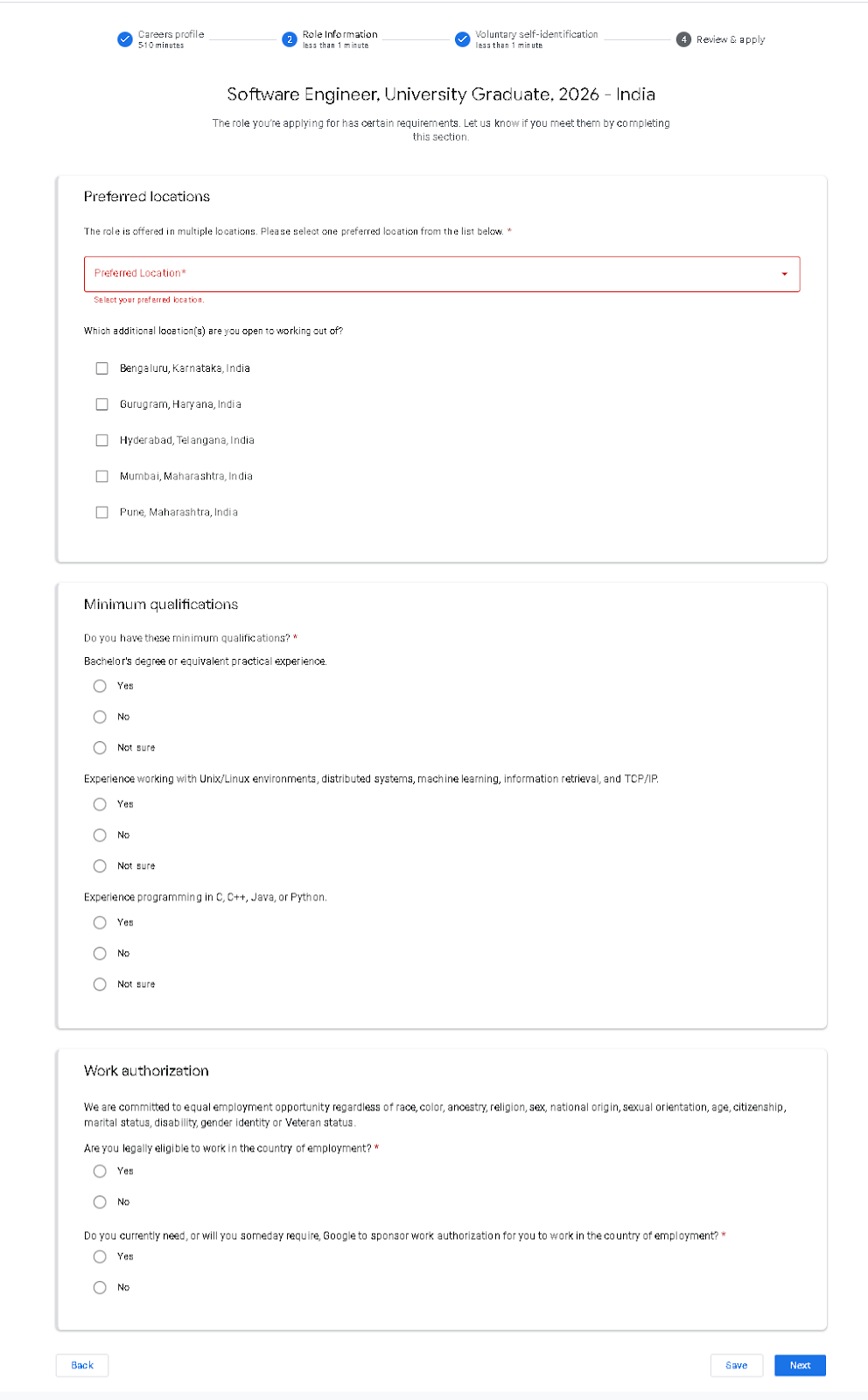
Visit Google Careers and search for job openings that match your interests.
You will be redirected to the next page. Fill in all the required details in the form and click ‘Save’ and then ‘Next’.
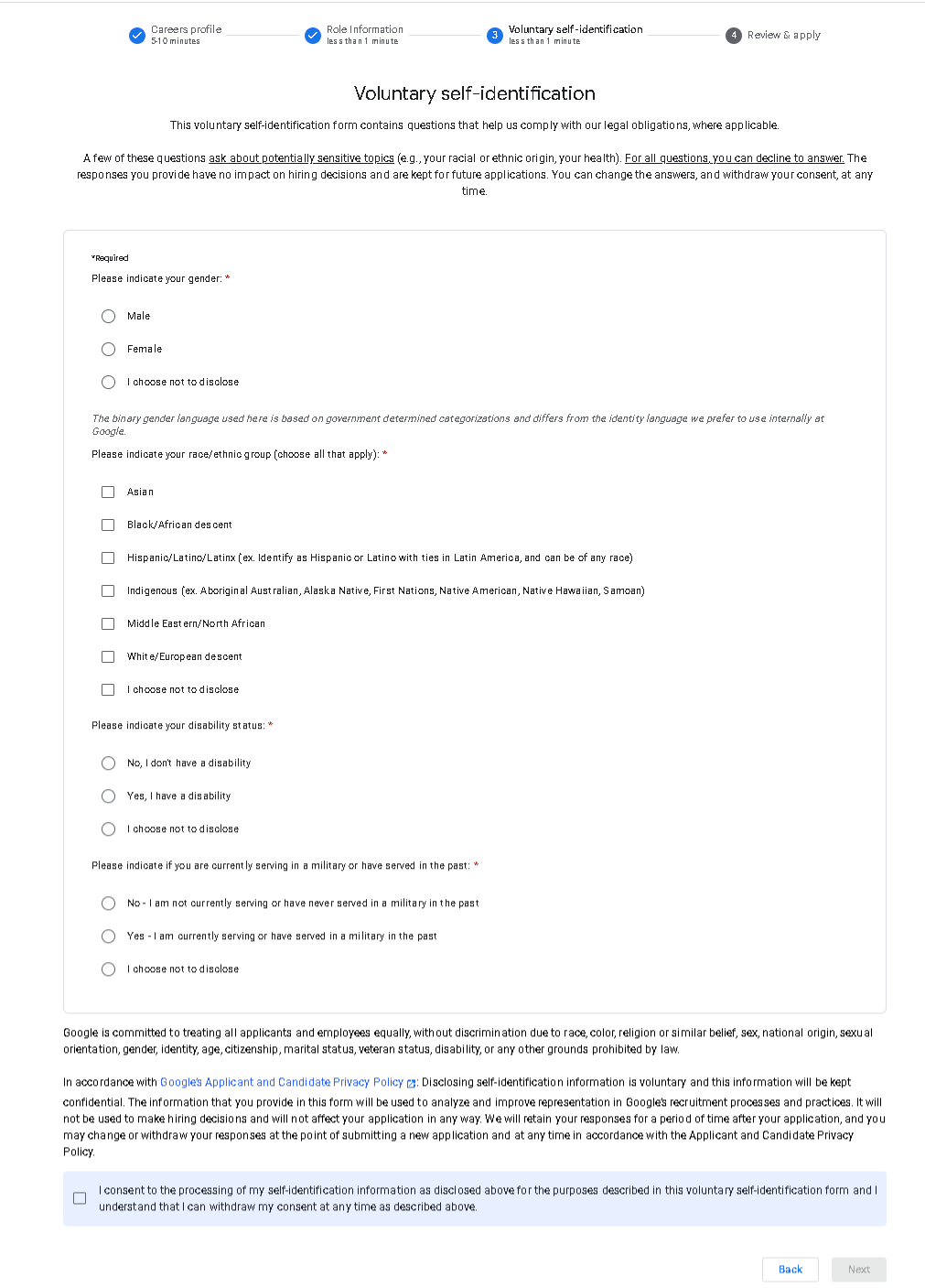
3. In the following page, provide all the self-identification details, then tick ‘I consent’ and proceed by clicking ‘Next’.
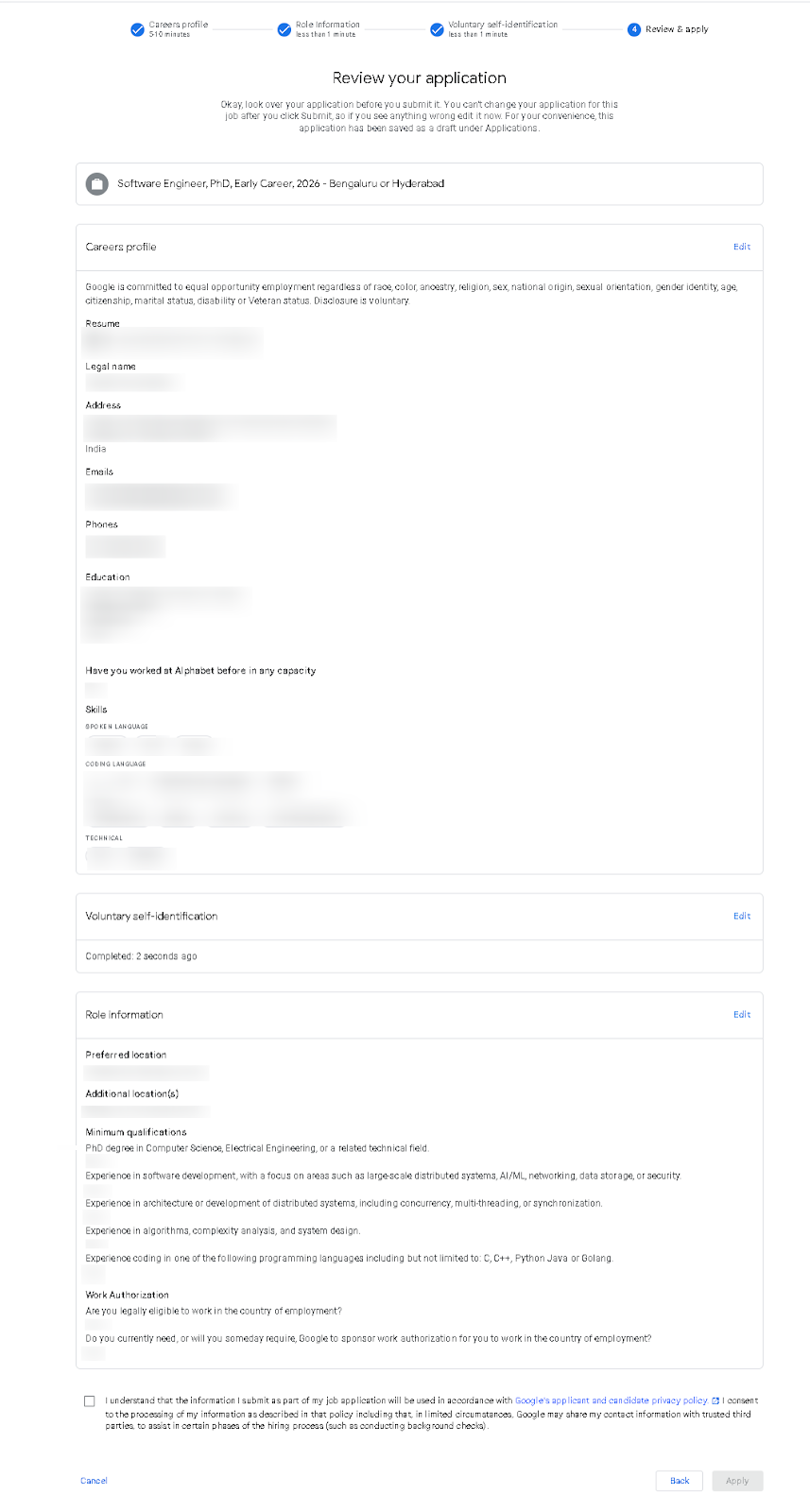
4. Here, all the details you entered will be displayed. Review them carefully, and if you need to make any corrections, click ‘Edit’, update the information, and ‘Save’. Finally, tick ‘I understand’ and click ‘Apply’ to submit your application.
5. In the next step, all the applications you have submitted will be displayed, and you can track their status.
Google Selection Process
The Google recruitment process is designed to evaluate candidates thoroughly across technical skills, problem-solving abilities, and cultural fit. Below is an overview of the main stages you can expect during the hiring process.
1. Online Assessment
Google’s OA evaluates analytical thinking and coding ability.
Section
Topics
Coding Round
Arrays, Strings, Graphs, Trees, DP, Greedy
Debugging
Code correction, bug identification
Logical Reasoning
Puzzles, sequences, analytical problems
2. Phone Screening
Duration: 45–60 minutes
This is a technical coding round conducted on Google Docs or a similar environment.
Includes:
1–2 DSA questions
Time and space complexity discussion
Follow-up variations
3. Technical Interviews (3–5 Rounds)
Google assesses deep technical knowledge in the following areas:
Category
Sample Questions
Data Structures & Algorithms
Implement a function to reverse a linked list.
Find the lowest common ancestor in a binary tree.
Detect a cycle in a directed/undirected graph.
Merge two sorted arrays without using extra space.
Implement an LRU (Least Recently Used) cache.
Dynamic Programming
Solve the classic knapsack problem.
Find the number of ways to climb stairs with n steps.
Maximum sum subarray (Kadane’s algorithm).
Arrays & Strings
Find the subarray with the maximum sum.
Rotate a matrix 90 degrees clockwise.
Check if a string is a palindrome or can be rearranged into one.
System Design (for experienced roles)
Design a URL shortening service like bit.ly.
Design a messaging system similar to WhatsApp.
Build a scalable file storage system.
General Programming & Logical Questions
Write a function to calculate factorial using recursion.
Find the nth Fibonacci number efficiently.
Implement a function to find the first non-repeating character in a string.
Databases / SQL
Write a query to find the second-highest salary in an employee table.
Normalize a database schema for a library system.
Design efficient indexing strategies for large-scale data retrieval.
Tip: Google places strong emphasis not only on the correct solution but also on problem-solving approach, code clarity, optimization, and communication. Make sure to explain your thought process while solving each problem during the interview.
4. HR/Behavioural Round
Google uses the “Googleyness” evaluation model, which checks:
Leadership
Problem ownership
Teamwork
Learning mindset
Cultural alignment
Sample HR Questions
Could you tell me about yourself and your background?
Why do you want to work at Google?
Describe a challenging situation you faced in a team and how you handled it.
What motivates you in your work?
How do you prioritize tasks when working on multiple projects?
Explain a time when you made a mistake at work and how you corrected it.
Where do you see yourself in the next 3–5 years?
How do you handle stress or tight deadlines?
Describe a situation where you showed leadership or initiative.
What are your strengths and weaknesses?
How would you handle a disagreement with a colleague or team member?
Tell us about a project or achievement you are most proud of.
Tip: Google values honesty, self-awareness, and clear communication. Be prepared to provide specific examples from your experience, and explain your thought process while answering situational or behavioural questions.
Types of Interviews and Assessments at Google
Google hires in a pervasive and detailed manner. Part of this evaluation includes different interview formats and assessments that mainly focus on the technical knowledge, problem-solving, and cultural fit of the candidate. Candidates should be very clear about these formats if they want to handle each stage with confidence.
1. Online Assessment
The process often begins with an online assessment, which may include a coding challenge, logical reasoning tasks, or a workstyle survey. These tests are designed to measure your analytical thinking, coding ability, and how your work style aligns with Google’s expectations.
2. Technical Phone Screen
Candidates who pass the initial assessment are invited to a technical phone screen. This round typically involves solving coding problems in real time, discussing time and space complexity, and answering follow-up questions. For some roles, this may also be referred to as a technical interview or coding round.
3. Take-Home Assessment
Depending on the role, Google might provide a take-home assessment. For a software position, a candidate might be expected to provide a solution to a coding problem independently. If the role is in marketing, product management, or design, then it could be a case study, a mock campaign, or a product roadmap exercise. These tests help the company understand how you can solve real-world problems and how effectively you can communicate your thought process.
4. Onsite Technical Interviews
The candidates who are selected from the shortlist will have to appear for a series of in-person technical interviews. They may have to face several coding tests, system design interviews (generally for experienced or senior positions), and problem-solving activities. The system design interviews help the company understand how you can come up with solutions that can be scaled easily. Coding rounds, on the other hand, mainly deal with algorithms, data structures, and writing efficient code.
5. Behavioural Interview / Googliness Round
Along with the candidates' technical skills, Google puts a lot of emphasis on the cultural fit of the candidate through behavioural interviews, which are referred to as the "Googliness round". The interview assesses the candidates' attributes, including leadership, teamwork, adaptability, and their alignment with Google's values. You will get more hypothetical questions in this stage about how you solve problems, how you work with others, and how you demonstrate the traits that Google is most concerned with.
6. Role-Specific Assessments
Some roles may require a workstyle survey or additional job-related tasks as prerequisites before a final decision is made. For instance, product candidates may need to prepare a product roadmap presentation or analyse a business case study.
Key Terms in Google’s Interview Process:
Googliness round: Behavioral interview focused on cultural fit and core values.
Behavioral interview: Assesses interpersonal skills, leadership, and problem-solving in real scenarios.
Case study: Real-world business or technical problems, often for product or marketing roles.
Mock campaign: Marketing exercise to evaluate creative and strategic thinking.
Online assessment: An initial screening focusing on coding, logic, or workstyle.
Product roadmap: A planning exercise for product management candidates.
System design interview: Determines the ability to architect scalable systems.
Take-home assessment: An independent project or coding challenge.
Technical phone screen: Live coding and technical Q&A conducted via phone or video.
Workstyle survey: An assessment of work preferences and compatibility with Google's environment.
Knowing these different types of interviews and assessments, candidates can develop better preparations for each stage and showcase their full potential throughout the Google recruitment process.
Documents Required for Google Recruitment
Updated Resume
Government ID Proof
Degree Certificates
Internship/Experience Letters
Portfolio/GitHub Links
Passport-size Photographs
Preparation Tips for the Google Recruitment Process
To maximize your chances of success and learn how to get a job at Google, here are some key tips to help you navigate the process:
1. Understand Google’s Work Culture and Values
Before technical preparation, research Google’s mission, values, and products. Understanding their focus on innovation, teamwork, and creativity helps you align answers with their expectations. Be ready to explain how your goals and work style match Google’s culture.
2. Master Data Structures and Algorithms (DSA)
Technical rounds focus heavily on coding and problem-solving. Build a strong foundation in key data structures like arrays, trees, and graphs, and practice algorithms such as sorting, recursion, and dynamic programming. Use platforms like LeetCode and HackerRank, and be ready to discuss time and space complexity.
3. Practice System Design and Core Concepts
Google evaluates system design and scalable solutions for senior positions. You should get familiar with design patterns, distributed systems, and the trade-offs in your designs. Moreover, you can practice design explanations with the help of diagrams or by taking real-world examples like messaging apps or caching systems.
4. Enhance Coding Speed and Accuracy
Google interviews are short, so you should practice coding efficiently and accurately. Focus on producing clean, bug-free code, debugging, and handling edge cases. Additionally, it is essential to explain your thought process while coding clearly.
5. Improve Communication and Behavioural Skills
Google is interested in the candidate's soft skills and cultural fit. You should practice concise explanations of projects and solutions, as well as answering behavioural questions using the STAR method. You should also prepare answers to questions related to teamwork, leadership, and motivation, and work on improving your listening and communication skills simultaneously.
6. Mock Interviews and Peer Feedback
You can practice real interviews with your peers or use a platform such as Pramp. You can then identify your weaknesses by reviewing solutions, and you can also work on the time management, problem-solving, and communication skills that the feedback refers to.
7. Stay Calm and Positive
Maintain a positive attitude and approach problems logically. You should stay calm under pressure, take a break if necessary, and keep in mind that interviewers are more interested in the way you solve the problem than in the final answer.
Bottom Line: By concentrating on these strategies of preparation, you will be in a good position to successfully pass the Google hiring process and get your dream job.
Google Salary Packages 2025
Here’s a look at the typical compensation packages that Google offers in India for different technical roles. These figures are based on reported data from recent years and reflect a combination of base pay, bonuses, and equity.
Job Role
Average Salary (INR)
Software Engineer
₹28,00,000 – ₹49,00,000
Data Scientist
₹31,00,000 – ₹53,00,000
ML Engineer
₹38,00,000 – ₹64,00,000
SRE
₹26,00,000 – ₹48,00,000
Product Manager
₹26,00,000 – ₹48,00,000
Cloud Engineer
₹30,00,000 – ₹54,00,000
Intern (SWE)
₹9,20,000 – ₹26,20,000
Candidate Experience Joined at Google
I applied for the Software Engineer (SWE) role through the official Google Careers portal. The application process was straightforward, and I ensured that my resume effectively highlighted my academic achievements, projects, and technical skills. After submitting my application, my resume was shortlisted, and I was contacted for the initial screening stage.
The first step after shortlisting was a brief coding assessment consisting of two coding questions. These questions were designed to test my problem-solving skills and understanding of data structures and algorithms. I spent time carefully analyzing the problems, optimizing my approach, and writing clean code to ensure correctness and efficiency.
Following this, I had a phone screening with a Google engineer. During this round, I was asked a single, moderately complex DSA problem on trees, which required me to demonstrate logical thinking, a clear approach, and coding proficiency. The interviewer also asked a few follow-up questions to test my depth of understanding and coding efficiency.
Once I cleared the phone screen, I was invited for the onsite rounds, which were challenging yet highly structured. These rounds primarily focused on problem-solving, algorithmic thinking, and logical reasoning, with questions designed to assess creativity and coding accuracy under time constraints. Each round involved different interviewers who evaluated my approach, coding style, and ability to clearly communicate technical solutions.
After completing the on-site interviews, my performance was reviewed by the hiring committee, which approved my candidature. Shortly afterwards, I received an official offer letter, along with a team-matching process that allowed me to understand the projects and teams I could join.
Basically, it was a perfectly seamless and thoroughly professional experience throughout the entire duration. The individuals with whom I had the interview were charming, and they encouraged me to explain my thought process, which was highly beneficial to me in navigating the tough rounds. The entire hiring process at Google is rigorous yet equitable, focusing on the candidate's problem-solving abilities, reasoning skills, and cultural fit. Such a method turns out to be a wonderful experience for any candidate who dreams of working in a global tech giant.
Quick Note: The recruitment process at Google is rigorous but well-organised, focusing on technical skills, problem-solving, and cultural fit. Success comes through clear communication and being well-prepared.
Conclusion
In conclusion, knowledge of the hiring process and getting ready accordingly is what matters if you are looking for Google jobs locally or investigating career prospects for new graduates in India. Working at Google is not only a job, but also a fantastic opportunity to be part of revolutionary technology. If you equip yourself with the technical skills that are asked for, sharpen your problem-solving skills, and get ready for the behavioural questions, then you will be able to turn your dream of working at Google into reality.
Why It Matters?
The recruitment process at Google should be thoroughly understood by all those who aspire to work there. It allows the candidates to make detailed preparations, match their skill sets with the job requirements, and show confidence during the technical and behavioural interview rounds. By preparing efficiently, one can secure a Google job, whether as a fresher or in an experienced role, thereby opening the way for career progression and global opportunities.
Practical Advice for Learners
Apply via Google careers India or competitions.
Master DSA, coding, system design, and communication.
Prepare for behavioral rounds using the STAR method.
Focus on both technical excellence and cultural alignment.
Frequently Asked Questions
1. How many rounds are there in the Google interview?
Typically 5–7 rounds, including OA, phone screen, and technical interviews.
2. Is the Google interview difficult?
Google interviews are challenging but manageable with strong DSA preparation.
3. Do freshers get hired at Google?
Yes, Google hires freshers through on-campus drives, off-campus hiring, and coding competitions.
4. What skills are required to join Google?
DSA, problem-solving, system design (for experienced), OOPs, OS, DBMS, and good communication skills.
5. Does Google hire non-CS graduates?
Yes. If you demonstrate strong coding, problem-solving, and technical understanding, branch doesn’t matter.
Rukmini Modepalli is an SEO Content Writer with 3+ years of experience creating high-quality educational content across Computer Science, technology, and career development domains. Passionate about making learning accessible and engaging, she specialises in transforming complex technical topics into easy-to-understand, value-driven content for students, job seekers, and professionals.
Her expertise spans SEO content strategy, technical writing, coding tutorials, interview preparation content, and educational resources designed to align with user intent and improve organic visibility. By combining research, storytelling, and SEO best practices, Rukmini creates content that educates, inspires, and helps learners achieve their academic and career goals.





.avif)